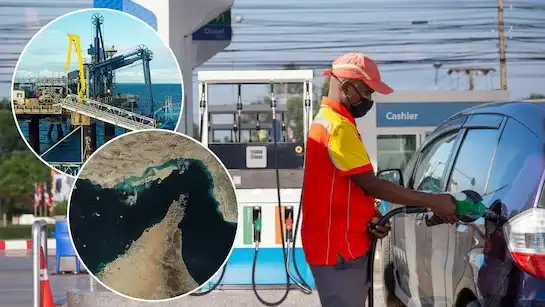
The skyrocketing prices of crude oil in the international market have completely shaken the global economy. In neighboring countries like Pakistan and Bangladesh, fuel prices have left ordinary citizens at their wits’ end; Nevertheless, petrol and diesel prices in India have remained stable for quite some time. Despite global turmoil and supply chain disruptions, the calmness maintained in Indian markets seems nothing short of a miracle. Why are Indian oil companies refraining from increasing prices—even though they are incurring huge losses—and what is the government’s strategy behind this?
Global crisis and situation in neighboring countries
Internationally, crude oil prices are showing a continuously increasing trend. The main reason for this is the increasing tension in the Middle East and disruptions in the supply chain due to the Russia-Ukraine war. While countries like Pakistan and Bangladesh are in a state of chaos due to acute shortage of oil and skyrocketing prices, the situation in India remains under control. In some areas, rumors have led to people trying to stockpile fuel at petrol pumps; However, the truth is that India’s energy management looks very strong at the moment.
Security cover provided by government oil companies
Government-owned oil marketing companies (OMCs)—such as Indian Oil (IOCL), BPCL, and HPCL—play a key role in maintaining stable petrol and diesel prices in India. Despite rising global prices, these companies are bearing the burden of losses themselves instead of passing it on to the public. In previous years, when crude oil prices were low, these companies had made huge profits. Now, the same profits are being used to compensate for the increased prices in the international market, thereby ensuring that domestic prices do not rise.
Big challenge to control inflation
Fuel prices are directly related to the inflation rate of a country. If the prices of petrol and diesel increase, the costs associated with freight and transportation also inevitably increase. This has a direct impact on the prices of fruits, vegetables and other essential commodities. The current priority of the Government of India is to keep inflation within a fixed and controllable limit. This is why the government has instructed oil companies not to make any changes in prices until the price of crude oil crosses a certain limit (about $130 per barrel). **Tax structure and buffer stock strategy**
In India, taxes (which include excise duty and VAT) constitute about 40 to 50 percent of the final retail price of petrol and diesel. This high tax structure provides a ‘cushion’ (safety net) to the government. When international prices rise significantly, the government has the option of cutting excise duty. Furthermore, India has replenished its strategic oil reserves in recent times. The country now has adequate fuel reserves to meet its domestic needs in the event of any short-term crisis or supply disruption.
Exploration of alternative supply routes
Amid rising tensions on sensitive sea routes—such as the Strait of Hormuz—India has started actively working on identifying alternative sources and routes for oil imports. Instead of relying on any one region, India is now diversifying its sources of crude oil by increasing imports from Russia, Africa and various Latin American countries. Oil purchased from Russia at concessional rates has also served as a shield, protecting India from the shocks of volatile global prices. As a result, the average cost of purchasing oil remains relatively low for oil companies, allowing them to pass the benefits of stable prices on to consumers.
old balance of profits and losses
From the perspective of oil companies’ balance sheets, this process works in a cyclical manner. Experts point out that companies recover their losses during periods when crude oil prices fall, provided that retail prices of petrol and diesel are not cut at the same time. This mechanism is called “recovering under-recoveries”. Currently, companies are buying oil at inflated rates in the international market, but selling it at lower prices in the domestic market—a difference that is expected to balance out in the future, when crude oil prices eventually moderate. Perhaps this is the main reason why no significant volatility is being seen in the market at present.