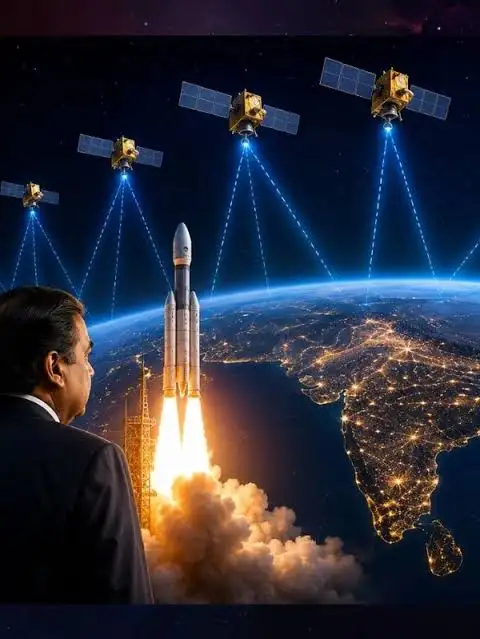
India has taken a big step towards the satellite internet revolution. Reliance Jio’s ambitious plan to launch 1,600 low-Earth orbit (LEO) satellites has received the necessary technical approval from the Indian National Space Promotion and Authorization Center (IN-SPACE). According to an ET report, with this approval, Jio comes closer to building India’s first indigenous satellite constellation (network of satellites). With this step, Mukesh Ambani’s dream of providing high-speed internet to every corner of the country through space-based technology will come true.
**Approval for 1,600 satellites**
Government officials, speaking on condition of anonymity, told the media that the space regulator, IN-SPACE, considers Reliance Jio’s proposal to deploy around 1,600 LEO satellites as “technically sound” and at par with global systems like Starlink. This assessment was done jointly by IN-SPACE, Indian Space Research Organization (ISRO) and Wireless Planning and Coordination (WPC) wing of the Department of Telecommunications (DoT). After this approval, the government can provide regulatory support at the international level to Mukesh Ambani’s company to get the orbital slot. The company had sought the government’s help in obtaining orbital rights through International Telecommunication Union (ITU) filings and coordination with other organizations.
This development paves the way for India to build its first indigenous LEO constellation – a vital asset for national security and strategic defense needs. The LEO sector is currently dominated by Elon Musk’s Starlink, which operates a fleet of more than 10,000 satellites. However, due to geopolitical tensions, countries are trying to reduce their dependence on foreign satellite companies. A person with knowledge of the matter told ET that Jio’s planned capacity is its largest offer for India so far. The company has proposed to provide a throughput capacity of 4.5-5 terabits per second (Tbps) in India.
fixed satellite service
In comparison, Starlink has approval for 600 gigabits per second (Gbps), while Amazon LEO plans to offer 3 Tbps of capacity in India, although the company is yet to get approval from IN-SPACE. Another person said that the orbital dimensions, configuration and architecture of Jio’s constellation will help it work together with other Indian constellations in the future. According to the proposal, Jio plans to offer fixed satellite services – such as broadband and cellular backhaul – as well as mobile satellite services, such as direct-to-device connectivity. The company intends to install 20-22 ground stations.
Space regulator’s advice to the government
In its recommendation to the government, the space regulator stressed the advantages of Jio’s proposal, including meeting strategic defense needs and reducing dependence on foreign companies. The regulator believes that the company should get regulatory and policy support so that India can achieve its first indigenous non-geostationary (NGSO) constellation. In addition to the technical assessment, there have also been preliminary high-level discussions on the possibility of placing defense payloads on specific LEO satellites.
What does this mean for the average consumer? Changing the whole situation: Till now, it was very difficult and expensive to provide internet facility by laying fiber-optic cable to every village due to geographical challenges (such as mountains, dense forests and groups of islands). However, satellite Internet will completely change this situation.
5G-like speeds even in mountains and forests: From the remote hill villages of Uttarakhand to the forests of the Northeast, high-speed broadband connectivity will be available straight from the sky.
Affordable Internet: Jio has always been known for its ‘aggressive pricing’ (low prices). Being an indigenous network, it is expected that Jio’s satellite internet will be much cheaper than foreign companies (like Starlink).
Helpful during disasters: Satellite internet will continue to work without any interruption even during floods, earthquakes or cyclones, whereas mobile towers may stop working at that time.