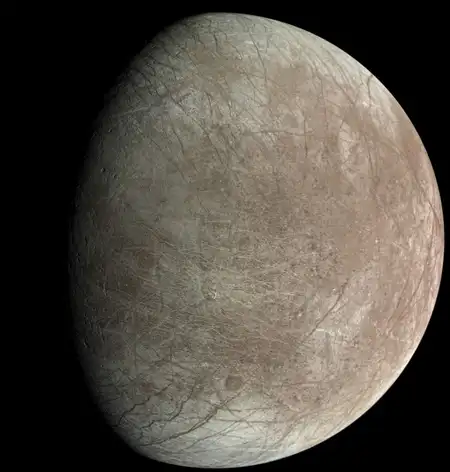
New Delhi, May 4 (IANS). In the search for places other than Earth in our solar system where there is possibility of life, scientists’ attention is most on Jupiter’s moon Europa. Europa is estimated to contain more than twice as much water as Earth, although its surface is so cold that all the water has frozen into ice.
Scientists believe that there may be a liquid ocean beneath this icy layer, where signs of life can be found. Europa is the smallest moon of Jupiter. It is slightly smaller than Earth’s Moon, but much cooler. The reason is its distance. Europa is five times the distance of Earth from the Sun. Very little sunlight and heat reaches here, due to which the surface temperature remains very low. The water present on the surface has become ice as hard as stone.
Scientists say that to break the ice here, a jackhammer will be required, not a normal ice pick. There is plenty of water in Europa. Scientists estimate that Europa has more than twice as much water as Earth. But all the water may not be hidden on the surface, but in liquid form under a layer of thick ice.
The Galileo mission of the American space agency NASA has provided strong evidence that a huge salty ocean exists beneath a thick layer of ice. Even on Earth, some organisms can live in a dark and harsh environment without sunlight, hence the possibility of microscopic life on Europa is also being expressed.
The surface on Europa may be frozen, but the interior remains warm. The main reason for this is the extremely strong gravity of Jupiter. Europa is constantly pulled by the pull of gravity as it orbits Jupiter. This drag creates friction inside, which generates heat. Due to this heat the water under the ice remains in liquid form. In addition, Jupiter’s other moons Io and Ganymede also gravitationally influence Europa. Due to these pulls, Europa’s orbit is not circular and keeps changing continuously. This process is called tides, which does not allow Europa to freeze completely.
To test all these possibilities, NASA has launched a spacecraft named ‘Europa Clipper’ in the year 2024. This mission will conduct a detailed study of Europa’s surface, ice layer and the ocean hidden below. Its main objective is to find out whether the necessary conditions for life on Europa are present or not. Europa study will not only increase the understanding of the solar system but will also tell how life can be possible on moons or planets other than Earth. Scientists hope that the ocean hidden beneath this icy moon can provide new direction in the search for life in the universe.
–IANS
mt/pm