
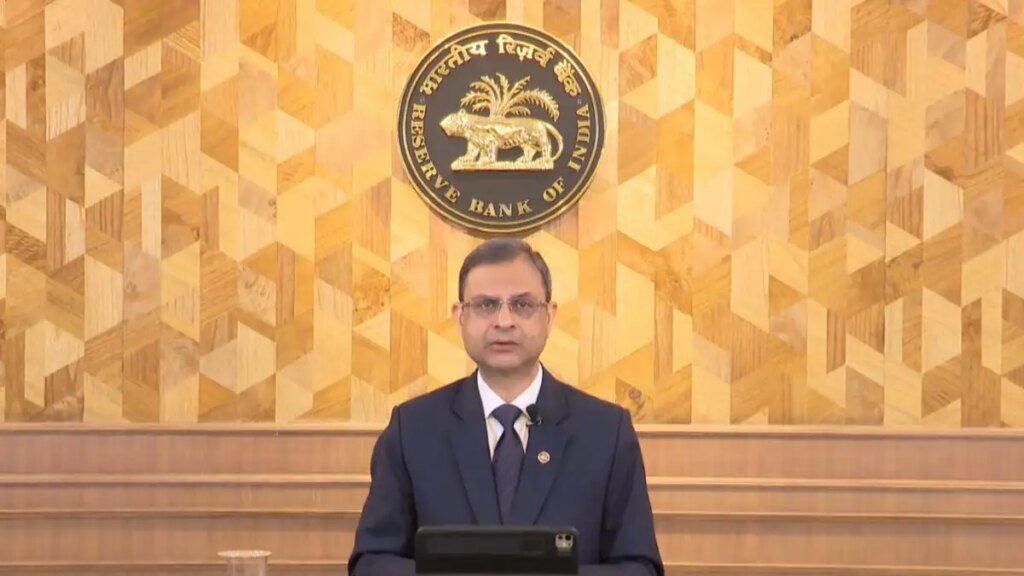
The Reserve Bank of India (RBI) has reduced the repo rate by 25 basis points to 5.25% in its monetary policy meeting on December 5, 2025. This will reduce the funding cost of banks and if banks pass this benefit on to customers, many loan installments like home and auto loans will become cheaper.
How does the effect of repo cut reach the customer?
When RBI reduces repo, banks start getting cheap money. Banks can cut their lending rates (especially on floating/benchmark-linked loans) — and then the EMIs come down or customers can save overall interest by reducing the tenure if they wish. Many economic sites are indicating that the new cut may bring down home loan rates and EMIs further.
Example: ₹20 lakh in 20 years – Mathematics (Step by Step)
The math below shows how a 0.25% reduction could result in a total savings of around ₹74–77 thousand (if banks pass through full profits and loan rates are reduced by the same proportion) —
● Assume – Loan amount (P) = ₹20,00,000
● Period (n) = 20 years = 240 months
● Standard initial annual interest (example) = 9.00% (say)
● Annual interest after deduction = 8.75% (9.00% − 0.25%)
EMI Formula (Decreasing-Interest) —
EMI = P × r × (1+r)^n / ((1+r)^n − 1)
Where r = Monthly Interest (Annual/12)
According to him:
Monthly EMI at 9.00% ≈ ₹17,995 ; Total payment in 20 years ≈ ₹43,18,685.
Monthly EMI at 8.75% ≈ ₹17,674; Total payment in 20 years ≈ ₹42,41,811.
Total savings (Interest + EMI difference) = ₹ 43,18,685 − ₹ 42,41,811 = ≈ ₹ 76,874 (approximately ₹ 77 thousand) – i.e. “about ₹ 74 thousand” can be broadly stated, as this figure can go up or down slightly depending on the introductory rate and bank policy. (The savings figure can be anywhere between ₹60–90 thousand at different starting rates).
Monthly Savings (EMI Event) — Summary
For example, in the above case the EMI will be reduced by ≈ ₹ 321 per month (₹ 17,995 − ₹ 17,674). Annual savings ≈ ₹3,852. This monthly savings in 20 years amounts to approximately ₹ 76-77 thousand.
Which borrowers will see the sharpest impact?
Those whose loans are floating-rate/repo-linked will get the fastest benefits.
Those taking new merchant home loans will also benefit from lower EMIs immediately.
If banks do not pass on the full share of the deduction, the savings will be less visible — so the impact will be different bank-wise.