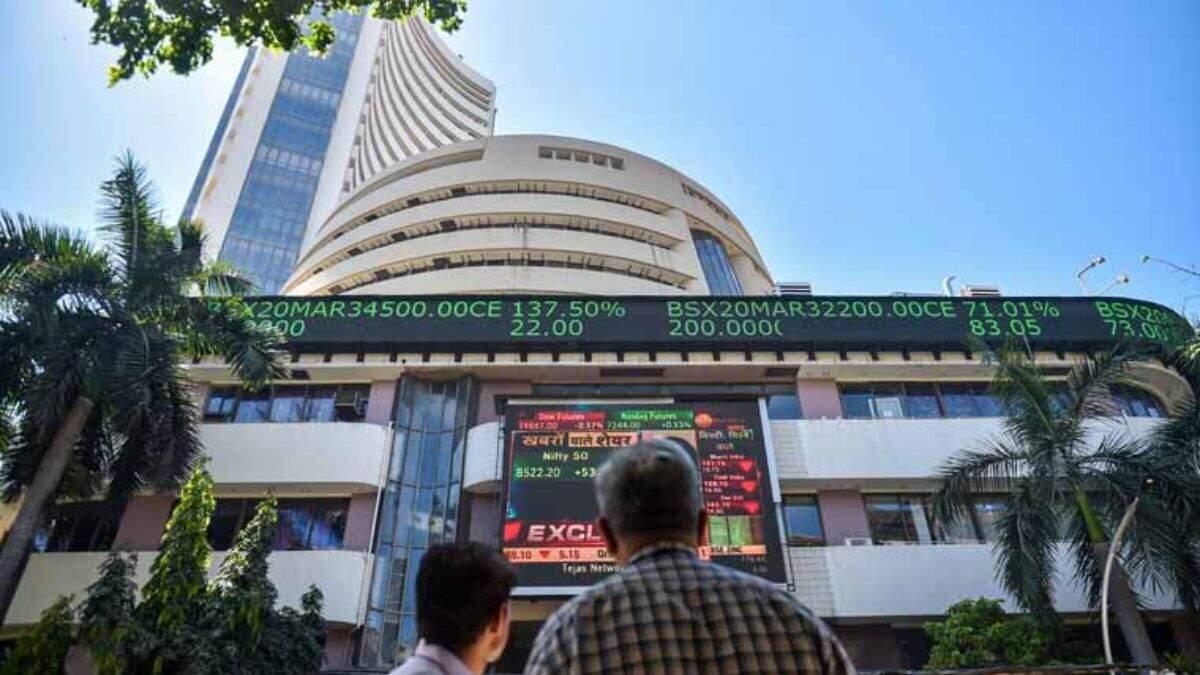
Despite an increase in Asian markets, the Indian stock market closed down on Monday (September 22) in the first trading session of the week. The market was seen to improve after the opening of a major recession. But at the end of the session, the selling once again dominated. The decline in IT shares pulled the market down due to strictness in H1B visa criteria. With the implementation of GST 2.0, the decline in the market intensified due to profits in some areas in the last one hour.
The 30 -share BSE Sensex opened 450 points to open at 82,151.07. However, the index was observed shortly after the opening. But the index declined due to profits in the last hour of business. Finally it closed at 82,179.43, declining 446.80 points or 0.54 percent.
Similarly, the Nifty-50 of the National Stock Exchange (NSE) also opened with a huge decline at 25,238. After some improvement during day trading, the selling dominated the last hour. It eventually closed at 25,202, declining 124.70 points or 0.49 percent.
Ponmudi R, CEO of SEBI-Penked Online Trading and Wealth Tech firm Enerich Money, said, “The decline in the Nifty was mainly due to heavy selling in IT sector shares. After a huge increase in the US H1B visa fee, concerns have increased about the profits of outsourcing companies. Along with this, weakened Rupees and strong US dollars.
He said that the Nifty continued to trade within a limited range throughout the day. Strong support remains at 25,150. While resistance was seen around 25,330. At the level of 25,200, strong put writing supported the decline. On the other hand, heavy call positions on 25,300 limited the boom. The Nifty tried to move above 25,350 once in the middle session, but the index fell again under selling pressure and touched 25,151 of the day. However, despite this decline, the Nifty remained above its major moving average. This shows that buyers are still active at lower levels.
Top losses and benefits
Among the Nifty-50 companies, Tech Mahindra, TCS, Infosys, Wipro, Cipla, HCL Tech, Tata Motors, Dr. Reddy’s Labs, IndusInd Bank, Reliance Industries, Trent and Jio Financial Services were included in the Nifty shares. These shares recorded a decline of 1 percent to 3 percent. On the other hand, Adani Enterprises, Eatran, Bajaj Finance, Adani Ports and UltraTech Cement were included in the top benefits shares. These shares saw an increase of up to 4 percent.
Pressure on broad markets also appeared clear. The Nifty Midcap index closed down 0.67 percent. While the Nifty Smallcap index declined by 1.17 percent. Meanwhile, the instability index India VIX also saw a sharp jump of 5.8%.
Talking about the sectoral index, the Nifty IT index recorded the highest decline of about 3 percent. After this, Nifty Pharma recorded a decline of 1.4 percent and Nifty FMCG by 0.5 percent. However, the Nifty Metal Index saw a strength of 0.5 percent.
IT sector stirred by new rules of H1-B visa
US President Donald Trump has announced major changes in immigration rules. Due to this, selling pressure was seen in the stock markets. IT stocks declined drastically. The Nifty IT index recorded a decline of 3 percent. Trump on September 19 announced a new executive order to increase the H1-B visa fee. This created an atmosphere of anxiety, nervousness and mistrust among thousands of Indian professionals working on H1-B visa.
Global market
Meanwhile, most of the Asian stock markets increased in the positive atmosphere after telephone talks between Trump and Chinese President Xi Jinping. Trump said he would meet Xi Jinping during the upcoming Asia-Pacific Economic Cooperation Summit.
Japan’s Nikkei was up 1.4 percent after Bank of Japan (BOJ) disclosed its huge exchange-traded funds (ETF) plans to sell to holdings. South Korea’s cospie rose 0.9 percent.
Wall Street’s shares on Friday closed with an increase amidst policy meetings and expectations of cutting interest rates. S&P 500 index and tech sector’s leading Nasdaq closed with a gain of 0.49 percent and 0.72 percent respectively.
GST 2.0 applicable from today
With the onset of Navratri, the cut in GST rates on essential commodities and vehicles has come into force from today. This change has made daily needs and vehicles cheap, which will directly benefit the common consumers.
The government has replaced only two main slabs – 5% and 18% – under GST reforms. In addition, a new tax bracket of 40% for ultra luxury goods has also been fixed. This change will affect the purchase of goods and consumers will get the same at a lower price.