Even in the era before the Internet, his fame was far and wide and his fans extended to Greece.
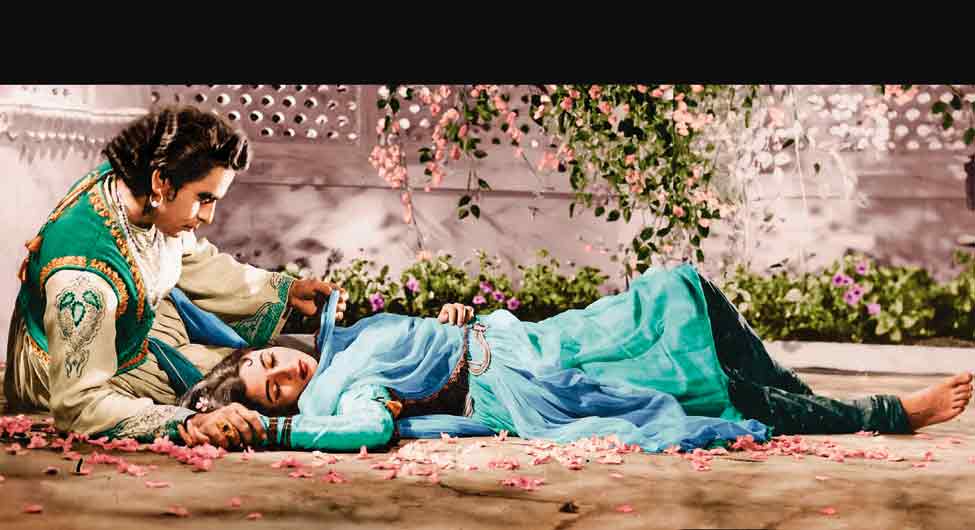
The image of Madhubala was remembered by the audience with a certain kind of tragedy or should we say sadness. It is possible that to a large extent the reason behind this was the immortal character of Anarkali of Mughal-e-Azam, which was woven with deep sadness. Those stories also contributed no less in creating such an image, which included stories of his heartbreak, being sick since birth due to a hole in the heart and then leaving this world at a very young age (36 years). His very short career also strengthened these notions. But looking at Madhubala only in this gloomy light would be unfair to her wide-ranging, artistic career. She was one of the most versatile artists of her time.
Over nearly two decades, he acted in approximately seventy-three films. This achievement is remarkable not only in terms of numbers but also in terms of diversity. At a time when the film industry often limited actresses to a limited scope, she still worked in different genres with ease. She could seamlessly slide into roles ranging from romantic fantasy, light comedy, dark drama, historical grandeur and musical entertainment.
Madhubala’s stardom was not only a matter of her own country, but her magic was cast on the hearts of distant countries too. He had set a wonderful example of global popularity even before the age of Internet. His star image unexpectedly reached even such far-flung places as Greece. The song ‘Madhubala’ is an example of that cultural fusion, where films crossed boundaries and became a part of popular culture. Sung by Greek singer Stelios Kazantzidis, this unique song presents Madhubala as a romantic fantasy character. The lyrics of the song ‘Madhubala’ make her the center of attraction, a face seen on the screen, a distant star, someone whose image evokes yearning.Is.
This was at a time when Indian images were used to convey romance and grandeur in European pop music. The global expansion of Hindi cinema in the 1950s and 60s often focused on stars whose expressions, that is, facial expressions, transcended language. The song ‘Madhubala’ was an example of this. His face was evidence of cultural diffusion before globalization. Madhubala’s screen presence, her facial expressions, music and mysterious close-ups made her popular abroad. In short, his expressions could be understood even without subtitles.
Madhubala also got some opportunities outside Indian cinema. It is said that Frank Capra, director of It Happened One Night (1934) and It’s a Wonderful Life (1946), wanted him to come to Los Angeles and work with him there. But Madhubala’s father rejected the offer due to his health and the uncertainty of working abroad. The knowledge that he had a hole in his heart limited his international career.
Madhubala’s acting was such that it connected with the heart even without dialogues. Her specialty was that she worked in coordination with other actors and would change her voice and expressions in a single scene. She used to say a lot even while remaining silent. Her singing was also amazing, even though there were other singers recording the songs, but Madhubala used to move her lips on them as if she was the one singing. His style made the song even more beautiful. She also used to sing informally and people who worked with her praised her understanding of tune and rhythm.
Madhubala used to get so immersed in the song that the song did not just play on the screen, but she lived the song. His breathing, facial movements and mischief in his eyes were so in sync with the tune of the song that it seemed as if his voice and body were coming from the same place. This specialty is rarely seen in today’s Bollywood. This was the reason why his songs became even more special.
Working with the same team in Madhubala’s films often brought a certain stability to her performance. Her comedy in Mr. and Mrs. 55 (1955) with Guru Dutt was amazing. Guru Dutt’s restrained style and Madhubala’s vivaciousness made a nice contrast. Her pairing with Dilip Kumar in films like Tarana (1951), Sangdil (1952) and Mughal-e-Azam (1960) showed that she could work equally with an emotional actor like Dilip Kumar, without copying his heavy style. In films like Kaala Paani (1958) with Dev Anand, he adopted a modern and urban style, which went well with Dev Anand’s charming personality and helped establish the signature chemistry of romantic thrillers of the 1950s.
Director K, who presents every scene very well in his films. Working with Asif, Madhubala’s acting style gained a certain stability and sculptural beauty. He stood out most in the prison scenes of Mughal-e-Azam (1960). He also did light films with actors like Kishore Kumar, who was also a very good comedian. She even married Kishore Kumar. Even while working with him, instead of trying to attract attention, Madhubala worked in harmony with his pace.
Madhubala’s sense of comedy is one aspect of her work that is underestimated in Hindi cinema. In films like Mr. & Mrs. 55, he showed that comedy required not only control, but also the courage to make oneself look a little silly. Madhubala understood this very well. The story of Mr. & Mrs. 55 revolves around a rich girl who is seduced and forced into a fake marriage by her domineering and patriarchal aunt to gain property wealth. The story presents women’s liberation and feminist politics as misogynistic, extremist, and anti-male. The story ultimately turns its heroine towards traditional domestic life, hinting that romantic love and male guidance are the forces that ‘improve’ modern female independence.
But even when the stories in the films had ideological limitations and were clearly anti-feminist, Madhubala’s presence made those stories more complex. Especially because at that time she was one of the highest paid actresses of Hindi cinema. Her earnings were an indication that it was very rare for a woman to have such economic power in that era. In fact, it is also true that she was a working woman who supported her large family, negotiated her own contracts and had a strong presence at the box office. All this was, to some extent, the contribution of feminism. Therefore, on one hand, her character promotes old thinking, while on the other hand, her success as a working woman goes against that thinking. Being modern and independent while working on old stories made her image special, as is the case with most female artists.
(Critic of film, TV and culture. Known for her media analysis from the perspective of gender, politics and power relations.)