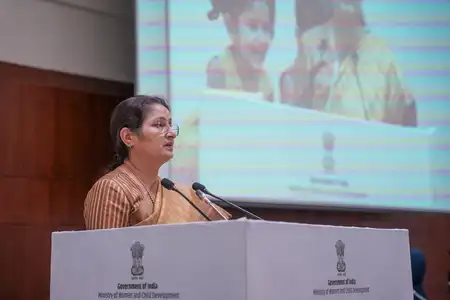
New Delhi, April 10 (IANS). According to Union Women and Child Development Minister Annapurna Devi, with more than 14 lakh Anganwadi centres, Anganwadi Didis are reaching out to pregnant mothers, lactating mothers, adolescent girls and children. Also, providing service to 8.9 crore beneficiaries.
He emphasized that ‘Poshan Maah’ and ‘Poshan Pakhwada’ have taken the form of a true ‘people’s movement’ in which crores of activities are taking place across the country.
Union Women and Child Development Minister Annapurna Devi said, “Our Anganwadi workers, Anganwadi assistants and Asha Didis are dedicatedly engaged in taking the vision and goals of the Prime Minister to every household through collective efforts. The responsibility of the Ministry of Women and Child Development is wide and we are reaching every household and every child across the country.”
He said, “Our children are the future of the nation and will carry forward the resolve of a developed India. It is the responsibility of all of us to ensure that they get better nutrition, which we have to fulfill together as a mass movement.”
He urged the states to learn from each other, adopt and adapt best practices and encourage better performance in districts, especially aspirational districts.
The Minister also emphasized that ‘nutrition’ is a continuous process and stressed the need for more time, care and community involvement to support the holistic and mental development of children.
Taking this national movement forward, the Ministry of Women and Child Development has launched the 8th edition of ‘Poshan Pakhwada’, marking the beginning of the nationwide campaign from April 9 to April 23.
Union Minister Savitri Thakur said that under the leadership of Prime Minister Narendra Modi, eight Nutrition Months and seven Nutrition Fortnights have been organized since 2018. Highlighting the need to maximize brain development in the first six years of life, he emphasized that this period is critical as more than 85 percent of brain development occurs in the early years, with the first 1,000 days being particularly critical.
He emphasized that there is a need to equally focus on sensitive care and early education to ensure holistic child development and not just limited to nutrition.
–IANS
SAK/PM