
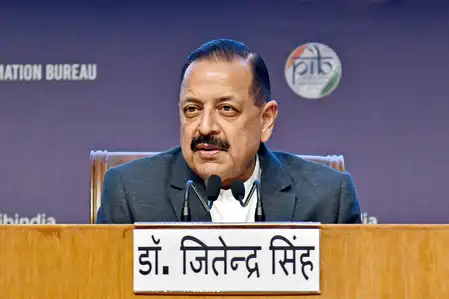
New Delhi, February 2 (IANS). Union Minister of State for Science and Technology (Independent Charge) Dr Jitendra Singh on Monday said affordable medicines, vaccines and diagnostics supported by domestic biomanufacturing will benefit the middle and weaker sections.
Speaking to the media after the Budget, the Union Minister said that it may take time to understand it completely, but the Budget reflects a clear, systematic approach where structural reforms are driven by cutting-edge technology and cutting-edge technologies are increasingly driven by AI.
The Union minister shrugged off concerns over benefits to the middle class, saying the budget is focused on reducing rising healthcare and living costs rather than short-term income gains.
He said that large-scale investment in biopharma, diagnostics, vaccines and gene-based treatments will significantly reduce the financial burden on families suffering from chronic diseases like cancer, diabetes and metabolic disorders.
The Union Minister said that more than 11-12 crore people in the country are diabetic and about 14 crore people are pre-diabetic. And the incidence of cancer is increasing rapidly and it is estimated that by 2030 there will be 20 lakh cases per year.
On the Rs 10,000 crore Biopharma Shakti Initiative, the Union Minister said that India has already emerged as a global bio-manufacturing hub and ranks among the top bio-economies globally and in the Indo-Pacific region.
He said this new investment will further strengthen this position by expanding capabilities in biologics, biosimilars, vaccines, medical devices and gene-based technologies.
The Union Minister described biotechnology as the next major industrial driver, comparable to the role played by IT in earlier decades. He said that the upcoming industrial revolution will be a bio revolution, which will include recycling, regeneration, circular economy and advanced life science innovations.
Dr Singh said the budget also included areas like non-communicable diseases and mental health, which were not given attention in the past decades. He announced that new super-specialty academic and clinical institutions for mental health would be set up in North India, ensuring broader and more equitable access to health services.
The Minister also highlighted the decision to set up new institutes of Ayurveda and pharmaceutical education and said that these initiatives will strengthen traditional medical systems and integrate them with modern research and healthcare delivery.
–IANS
abs/