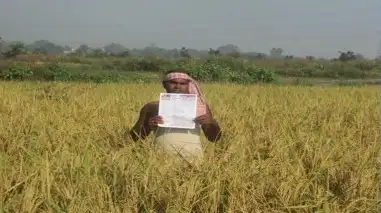
New Delhi, July 24 (IANS). The Central Government said on Friday that so far more than 25.89 crore Soil Health Cards have been issued under the Soil Health Card Scheme. At the same time, the scope of National Mission on Natural Farming (NMNF) has increased to 18,786 clusters, covering a total area of 8.80 lakh hectares. The government highlighted national efforts to promote scientific soil management and sustainable agriculture.
According to a government statement, around 7.17 lakh demonstrations have been conducted so far in collaboration with Agricultural Technology Management Agencies (ATMAs) and Krishi Vigyan Kendras (KVKs) to promote balanced fertilizer use under the Soil Health Card Scheme. Apart from this, farmers are being encouraged to adopt sustainable farming through public awareness programs like Khet Bachao Abhiyan.
The government said that so far 70,002 Krishi Sakhis have been trained so that they can provide advice and information related to soil health to the farmers at the village level. At the same time, under the School Soil Health Program, 4,430 schools and 1,29,167 students have been registered in the year 2025-26.
The statement said that the use of modern technologies such as digital platforms, geospatial mapping and Artificial Intelligence (AI) has made soil assessment and advisory services to farmers more effective. This is helping to increase agricultural productivity, combat climate change and strengthen long-term agricultural sustainability.
According to the government, more than 46 percent of the country’s workforce is employed in agriculture and allied sectors. In such a situation, the health of the soil directly affects the income of farmers, food security and economic stability of the country. Keeping this in mind, India has laid special emphasis on sustainable soil and land management, climate-friendly agriculture, natural farming, soil mapping and digital agriculture.
The statement said that schemes like National Mission for Sustainable Agriculture (NMSA) and National Mission on Natural Farming (NMNF) are promoting better use of resources and climate-friendly farming practices. At the same time, the Soil Health Card Scheme provides advice to farmers regarding the use of appropriate nutrients based on soil testing.
The government also pointed out that initiatives like National Mission for a Green India, National Mission for Sustainable Agriculture and Carbon Credit Trading Scheme are helping in increasing soil organic carbon and strengthening long-term carbon storage.
Under India’s National Determined Contribution (NDC) commitments, the Green India Mission (GIM) aims to create an additional carbon sink of 2.5 to 3.0 billion tonnes of carbon dioxide equivalent by 2030. According to the India State of Forest Report (ISFR) 2023, an additional carbon sink of 2.29 billion tonnes of carbon dioxide equivalent has been created in the country between 2005 and 2021, which shows India’s remarkable progress in this direction.
–IANS
DBP