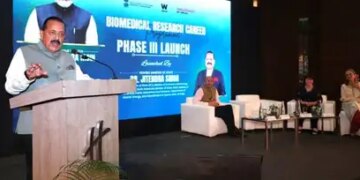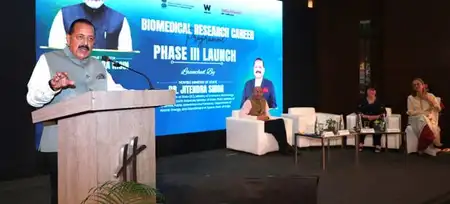
New Delhi, July 15 (IANS). The Central Government on Wednesday launched the third phase (Phase-III) of the Biomedical Research Career Program to give new impetus to health research and healthcare innovation in the country. A provision of Rs 1,500 crore has been made for this programme, which aims to promote fellowships, research grants and translation of scientific discoveries into practical health services.
The Ministry of Science and Technology said in a statement that Rs 1,000 crore will be provided for this program by the Department of Biotechnology (DBT) and Rs 500 crore will be provided by the London-based Wellcome Trust. This partnership is considered an important step towards strengthening biomedical research in India at the global level.
Union Minister of State for Science and Technology, Earth Sciences, Dr. Jitendra Singh said that the objective of this program is to create a world-class biomedical research ecosystem in India. Under this, experts like basic scientist, clinical researcher, public health expert, science communicator and research manager will be prepared. In addition, inter-disciplinary and collaborative research will also be encouraged.
He said this initiative will attract new international and philanthropic partnerships in the field of biomedical sciences in India, thereby increasing both the scope and impact of research investments.
Dr. Jitendra Singh said that biotechnology is going to be the main basis of India’s economic growth, scientific progress and global competitiveness in the coming years. He said that India’s bioeconomy has increased from $10 billion in 2014 to more than $195 billion by 2025 and is expected to reach $300 billion by 2030.
He also informed that about 12,000 biotech startups are currently active in the country. India is among the world’s leading vaccine manufacturers and is rapidly strengthening its identity as a global biotech hub.
During the programme, along with the formal launch of Phase-III, interactions were also held with scientists and researchers whose careers have been given a new direction by this initiative. Presentations were also given on the scientific achievements of the program and its long-term impacts.
Dr. Singh said that this program is an example of how important long-term partnerships can play in accelerating scientific research, creating world-class human resources and developing solutions to national and global health challenges.
He also called upon industry and philanthropic organizations to invest more in this sector, saying that India has no dearth of talent and innovation, but sustained financial support is essential to translate research into technology, diagnostics and affordable health services.
–IANS
DBP