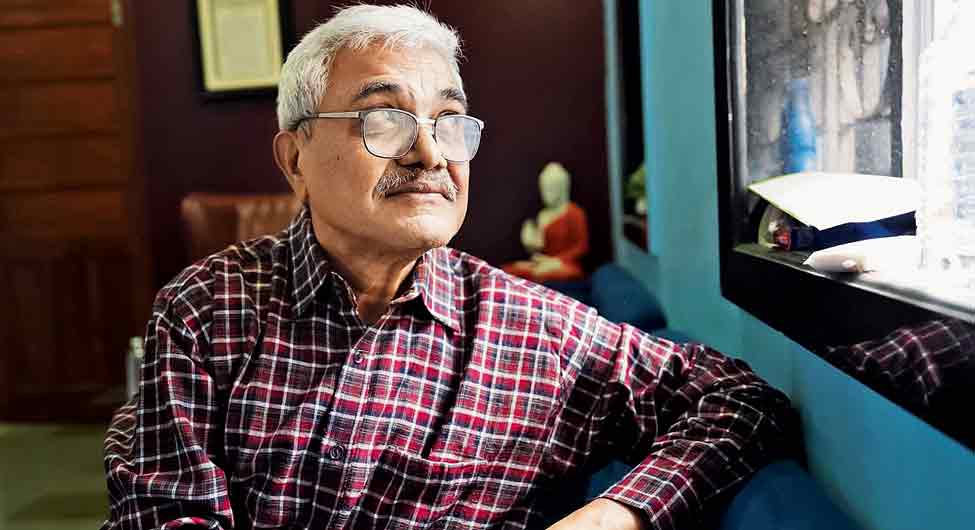
Jail is a factory of nonsense, which runs unabated every day. For example, every morning when the cells were opened, the ritual began with the rattling of sticks.
Much has been written on the tragic aspect of prison, but what has not been discussed much is its humorous aspect. Jail is a factory of nonsense, which runs unabated every day. For example, every morning when the cells were opened, this ritual started with the rattling of sticks. The guards would rub their batons hard against the steel bars, producing a deafening sound that sounded more like a declaration of status and power than an alarm. A question kept wandering in my mind that why only two or three always come? Only one guard could keep shouting while banging his baton loudly, “Hey, get up!” I once asked a guard why he did unnecessary work. He immediately said, “Rooster duty.” I said, I am not asking what he is doing, I can already see it, but I am asking why two people are needed for that. This took a philosophical turn. Pausing for a while, he uttered the most powerful mantra of the prison world, “Saab la vicharto”, (I ask the sir.)
“Sab la Vicharto” in jail is not a promise, it is a place where questions accumulate and answers are never found. Like the ritual of waking up in the morning, status comes to couples. Finally, in the ritual of the week, this comedy reaches its peak! Recalling such funny incidents during my lonely moments in the cell had become an interesting hobby of mine.
I clearly remember being implicated in the Bhima Koregaon case, especially the humorous aspect of it. When the Pune Police held a press conference on the documents recovered from the electronic devices seized from the first five arrested people, they openly announced that the scope of the conspiracy had spread. As if pre-arranged, a journalist asked the names. My name immediately appeared like a magician pulling a rabbit out of an empty hat. After some time, the police read out a letter, purportedly written by someone whom they had already identified as a Maoist. That letter was written to ‘Anand’, which was a firm claim that it was me. It was written in it that the seminar I attended at the American University of Paris was funded by his party. It felt strange to learn that my education had been so generously sponsored without my knowledge. I felt as if I was taking advantage of a secret scholarship run by an underground organization.
The thinking of the police does not go beyond the known limits. Everything has a price in their world. Then, the academic seminar must have a sponsor, the sponsor must have an agenda and the agenda must be a conspiracy. It is nonsense that universities invite scholars to speak. By this argument, there was a secret nexus between Indian Maoists and American universities!
The inconsistencies were so glaring that I started laughing when the officer was reading the letter with great seriousness, as if the truth was known by the seriousness of the face, and not by facts and logical consistency. My first lesson in this new epistemology was that facts are meaningless, seriousness of face is necessary. Later, in a rare incident, the High Court reprimanded this high-ranking police officer for informing the press before submitting the evidence in court. Unfortunately, the court was not aware that the officer had not only read the letter but had also distributed it among journalists like a pamphlet. When a journalist friend of a TV channel mailed the letter to me, I could not help but laugh.
When this story came out in the charge sheet, a lawyer friend cautioned me that it was no laughing matter. The charge sheet was filled with many other fabricated stories. In my naivety, I thought that when these stories reached court, they would automatically be discredited. Instead, during the hearing, the police handed over something in a sealed envelope and my bail plea was rejected. Frightened, I wrote an appeal to my countrymen, my hopes are dashed, I need your support. I also created a “see for yourself” template to help people get an idea of their chances of going to jail. It was a mockery of hopelessness, but it was also a manual for today’s citizenship. The template was something like this: One day, whatever your social status or not, you come to know that the police of some ‘A’ state has declared you a terrorist. While investigating a crime, he found a letter on someone’s computer which was written to ‘B’, who according to the police is you, and this letter was found at a place called ‘C’, where you had never been. This letter was written by ‘G’, who was said to be a member of a banned organization, in which it was said that you were present at a place named ‘Ch’, which you might not have even heard of. This was confirmed by a witness who heard someone say that he saw you there with someone else, who was said to be known to ‘G’. Now, replace these with the name of your choice, and congratulations, you are now an accused under the Unlawful Activities (Prevention) Act (UAPA). You lose your job, your family’s peace is snatched away, you are disgraced, friendships end and life becomes like a long legal commentary. Overall, it may seem worse than death, at least in death there is the solace of everything being over.
I thought such an incident would make people angry or at least arouse curiosity. But nothing like this happened. In my cell, I would often think of my appeal and laugh to myself at my foolishness. I realized that the people of the country have stopped worrying about such small problems and have moved forward. In a country where absurdities have become central to institutions, tragedy has to become funny to attract attention.
The first round of my petitions ended with the Supreme Court dismissing them, and showing me a small amount of judicial mercy by giving me a month to seek anticipatory bail from the ‘appropriate’ court. Thus began my second phase, in the lowest rung court in Pune, from where the case had originated.
Then I was invited as the chief guest at a meeting in Thrissur, where senior serving and retired government officials were present. It was a bit strange, although strange things were fast becoming a part of my life. While going to Kochi airport, I came to know that my application had been rejected. By then, rejection had become common for me.
At the airport, suddenly I chose one of the two tickets I had for Goa and Mumbai and reached Mumbai around 2 in the night. As soon as I came out, two policemen came and took me to the airport police station. I said that you are doing illegal work, because till then I had the protection of the Supreme Court. He replied that he was following the orders of his sir, this is an order which is above the constitutional instructions. Initially, they did not give me my phone, but later they gave it to me so that I could tell my wife waiting for me at home that I had been arrested. Soon Pune Police arrived and completed the papers like routine work. An officer checked the laptop in my bag. It was at the top, but he called it an iPad and moved on. I laughed in my heart at this classification of technology. Then, the 13 hours I spent in the dirty, smelly police lockup became for me a very practical lesson on Article 21 (right to life with dignity). No text book or constitutional text can give me a better lesson than this.
An orientation program was also available in the lockup. There I saw what was waiting for me in Taloja Central Jail, where I was going to waste 31 months of my life. In those 13 hours, the Constitution emerged not as a shield but as a noose, spoken of respectfully on the outside and neatly suspended on the inside.
Those hours reflected the prison curriculum: only humiliation and humiliation, food that could hardly be called food, toilets without doors; Endurance in a smelly environment and a life under constant stress. Cut off from the world during a pandemic that was being handled with bureaucratic brutality.
Looking back, the lockup worked exactly as it was supposed to. He taught me that dignity, like freedom, survives in prison only as a constitutional fiction. When the court later declared my arrest illegal and ordered my release, I laughed, the most ridiculous thing I had ever done in my life.
well! I got bail, it is my good fortune, it is almost impossible under UAPA. Although people often sing this song, “Bail is the rule…”
I still miss my big data, my students, friends, who are too afraid to keep in touch with me. I cannot accept invitations for lectures outside Maharashtra. About six universities of Europe had invited me for their fellowship/lecture, but the court refused. I mustered up the courage to seek permission for a litfest among more than a dozen invitations, but were rejected as ‘academic luxury’. I miss my normal life.
Well, getting bail is a bit of a relief because I have lost my life anyway! I still laugh at myself…at something that can’t be laughed at?