
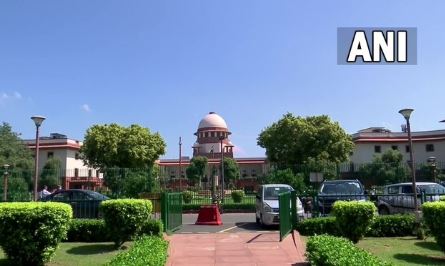
The Supreme Court on Monday refused bail to Umar Khalid and Sharjeel Imam, accused in the 2020 Delhi riots conspiracy case, but granted bail to five others citing “order of level of involvement” and saying not all the accused are on the same footing in the case.
Justice Arvind Kumar and Justice N. V. Anjaria’s bench said that a prima facie case is made out against Khalid and Imam under the Unlawful Activities (Prevention) Act (UAPA). Both of them will remain in jail but other accused Gulfisha Fatima, Meeran Haider, Shifa Ur Rehman, Mohammad Salim Khan and Shadab Ahmed have been granted bail.
According to the court, delay in trial is not a “trump card” that automatically circumvents statutory safeguards.
The bench said, “All the petitioners are not on equal footing in terms of guilt. The Court needs to review each petition separately, keeping in view the sequence of levels of participation emerging from the case of the prosecution.”
He said that the roles mentioned in relation to the accused are different.
The apex court said, “This Court is satisfied that the material produced by the prosecution prima facie proves the charges against the petitioners Umar Khalid and Sharjeel Imam… It is not appropriate to release them on bail at this stage of the proceedings.”
On December 10 last year, the apex court had reserved its decision on the bail pleas of the accused after hearing the arguments of Solicitor General Tushar Mehta and Additional Solicitor General SV Raju, appearing for Delhi Police, and senior advocates Kapil Sibal, Abhishek Singhvi, Siddharth Dave, Salman Khurshid and Siddharth Luthra, appearing for the accused.
Omar, Sharjeel and other accused are accused of being the “key conspirators” of the riots in north-east Delhi in February 2020. A case was registered against him under various provisions of the Unlawful Activities (Prevention) Act (UAPA) and the Indian Justice Code (IPC).
53 people were killed and more than 700 were injured in the riots in north-east Delhi. Violence had erupted in the area during widespread protests against the Citizenship Amendment Act (CAA) and the National Register of Citizens (NRC).
On September 2, the Delhi High Court had refused to grant bail to Omar and other accused in the riot conspiracy case. After this the accused had approached the apex court against that decision.
Delhi Police strongly opposed the bail pleas, saying that the riots were not spontaneous but were a planned, pre-planned and systematic attack on India’s sovereignty.
Raju had argued that all those involved in any conspiracy are accountable for each other’s actions.
He had said, “The actions of one conspirator can be blamed on others. Umar Khalid can be blamed for the speeches of Sharjeel Imam. Sharjeel Imam’s case will be considered as evidence against others.
The Additional Solicitor General had argued that Khalid had deliberately planned to leave Delhi before the riots because he wanted to avoid responsibility.
While seeking bail in the case, Imam had expressed his anger before the court that he has been declared a “dangerous intellectual terrorist” without any full trial or even a single conviction.
Senior advocate Siddharth Dave, representing Imam, quoted his client as saying that Imam was arrested on January 28, 2020, which is a time before the communal violence in north-east Delhi and the offense of “criminal conspiracy” in the riots case alone does not arise on the basis of his speeches.