
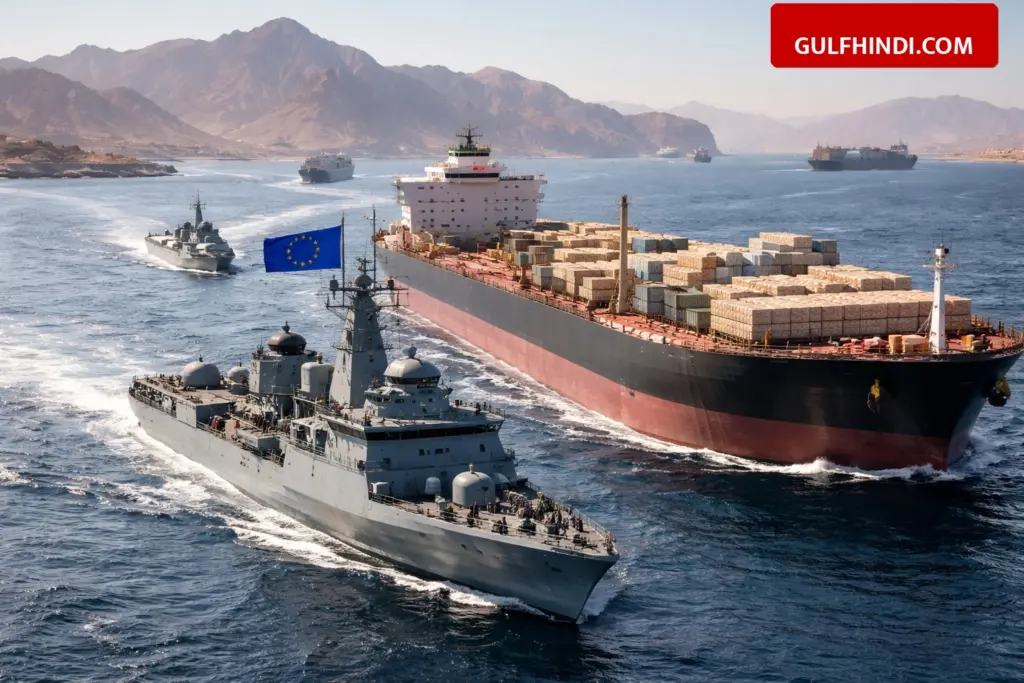
European Union (EU) High Representative Kaja Kallas has shared an important information amid the growing dispute in the Middle East. After the foreign affairs meeting held in Brussels on 16 March 2026, he said that resuming the movement of ships through the Strait of Hormuz is the biggest priority of the EU. Fertilizer, food and energy are supplied through this route. Stoppage of these things can cause a major crisis across the world and hence the EU is focusing on normalizing the situation.
What is the whole matter in Strait of Hormuz?
Due to the current dispute between Iran and America-Israel, the Strait of Hormuz is almost closed to commercial ships. This route is of great importance for the world economy.
About 20 percent of the world’s oil and LNG is supplied through this route. Due to the blockade, about 85 percent of the oil going to Asian markets has been affected. The EU believes that if the supply of fertilizers and food items does not start soon through this route, there could be a severe food shortage in the world by 2027.
EU’s new plan in collaboration with UN
Kaja Kallas has informed that she has talked with UN Secretary-General Antonio Guterres on a special initiative. It is being prepared like a Black Sea-style initiative. Under this, preparations are being made to create a safe international corridor so that commercial ships can pass without any fear.
There was also discussion on taking the EU’s Operation Aspides, currently running in the Red Sea, to the Strait of Hormuz. However, currently the member countries are insisting on resolving the matter through diplomacy instead of any direct military action in this area. The mandate of Operation Aspides has already been extended till February 2027.
What is its impact on Asia and India?
The closure of the Strait of Hormuz is a big problem for Asian countries because Asia is largely dependent on the oil coming through this route. Seeing this seriousness, India’s Foreign Minister S. Jaishankar also took part in the informal discussion held in Brussels.
The EU is using diplomatic channels to stabilize the situation so that any major regional war can be avoided. Along with this, the EU has also confirmed to provide humanitarian aid of more than 450 million euros every year to Palestine, Lebanon, Syria, Jordan and Egypt to handle the situation in the Middle East.