
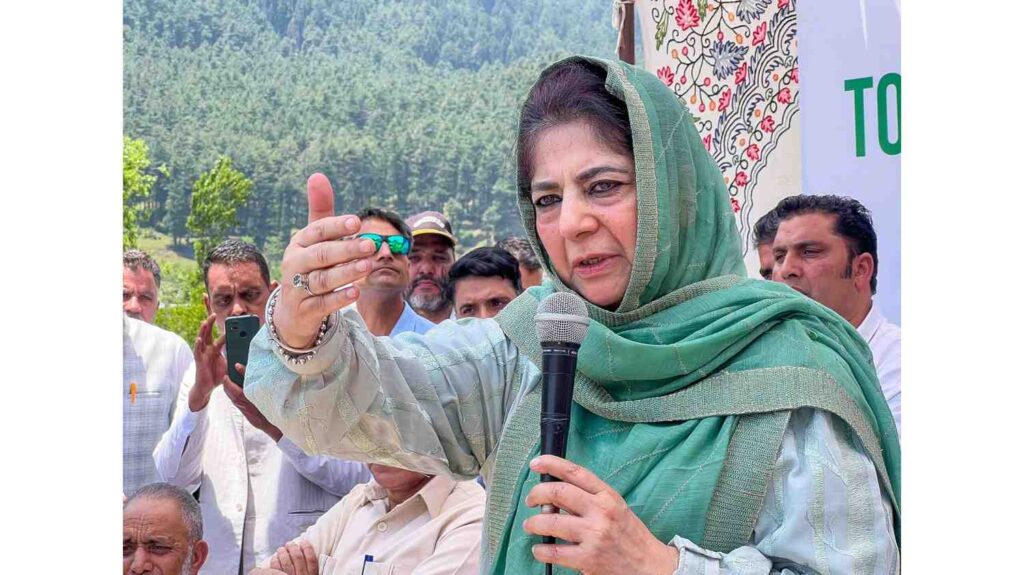
Former Jammu and Kashmir Chief Minister Mehbooba Mufti, in a letter to Home Minister Amit Shah on Friday, urged him to see the case of Yasin Malik of Jammu and Kashmir Liberation Front (JKLF) through a “human lens”. In a post, Mufti wrote that even though he was disagreened by Malik’s political ideologies, but he has to look for a way to renounce the path of political ideology and to choose the path of political association. Is impossible.
The post wrote, “I have written a letter to Shri Amit Shah ji to see Yasin Malik’s case from a human point of view. Although I disagree with his political ideology, his courage cannot be ignored to renounce violence and choose the path of political engagement and non -violent disagreement.”
In a letter to Shah, Mufti wrote that Malik’s story is not a simple story, and his confidence in the intense change and the state matters. The letter reads, “I appeal to your respected office to synonymically and immediately review the case of Yasin Malik. Yasin Malik is a name that was a symbol of resistance, later he has chosen the path of restraint and no longer the story of the prisoner. Is, because any story born of the struggle is not easy. The most important thing he made on the state and the state he renounced, when he renounced violence and chose the path of political engagement and non -violent disagreement. “
He further said that Malik’s efforts involved in a conversation with senior officials, intelligence personnel and controversial persons like Hafiz Saeed are a laborious and deliberate attempt to build a bridge in a deep divided area. The journey of Yasin Malik is not hidden from anyone.
Indian states. In 1994, he took a courageous and rare decision to adopt political, non -violent methods to lay down arms and change. According to his affidavits, this change was neither unilateral nor impaired, but also encouraged and accessible through secret agreements with Indian agencies. Over the years, Malik has been interacting with the silent consent of Indian agencies with senior officials, intelligence personnel and controversial persons like Hafiz Saeed. These efforts represent a laborious and deliberate effort to build a bridge in a deeply divided land, written in the letter.
Highlighting the required changes, Mufti wrote in the letter that it is unfortunate that Kashmiri is marginalized and his voice is excluded from the decisions that shaped their lives; If you want to create a safe environment for democracy, development and growth in the state, then the current circumstances will have to be changed.
“The world is changing rapidly, and enmity is bringing changes in global politics. Yet India does not need to make a fresh strategy to secure its strategic and economic interests.”
The post wrote in the post, “Visionary leaders like Atal Bihari Vajpayee ji and Dr. Manmohan Singh adopted this and adopted it with full confidence that the permanent power of our country comes from dialogue, not dominance. If you have to achieve permanent peace and safe environment for democracy, development and growth, then it will have to take a change of remedial touches of brutal force and restore constitutional rights. “
Further in his letter, Mufti requested to sympathy and consider Malik’s case, and said “for a person who has chosen the path of peace forever, raises the risk of breaking the delicate belief required for a meaningful dialogue.”
The letter further wrote, “I humbly request you to start a sympathetic and thoughtful review of Yasin Malik’s case. Close the door forever for a person who had ever chosen the path of peace, risks to break the delicate belief for meaningful interactions. If this belief is completely broken, every Kashmiri who feels completely disappointed and enlightened, if this faith is completely broken, if this faith is completely broken, it is broadcast. The consequences will back down from joining the Government of India. Such a result will continue the cycle of conflict and separation and end the hope of fixing this fragmented land for the coming generations. “
Malik was sentenced to life imprisonment in 2022 after being convicted under UAPA. The lower court admitted that its case does not fall in the “rare to rare” category to punish the death.
The NIA has accused others including Malik and Hafiz Saeed, Syed Salahuddin and Shabbir Shah of conspiring with groups in Pakistan to spread unrest in Kashmir. Earlier this year, a tribunal extended the ban on JKLF for the next five years, given that no tolerance to separatism could be seen “.