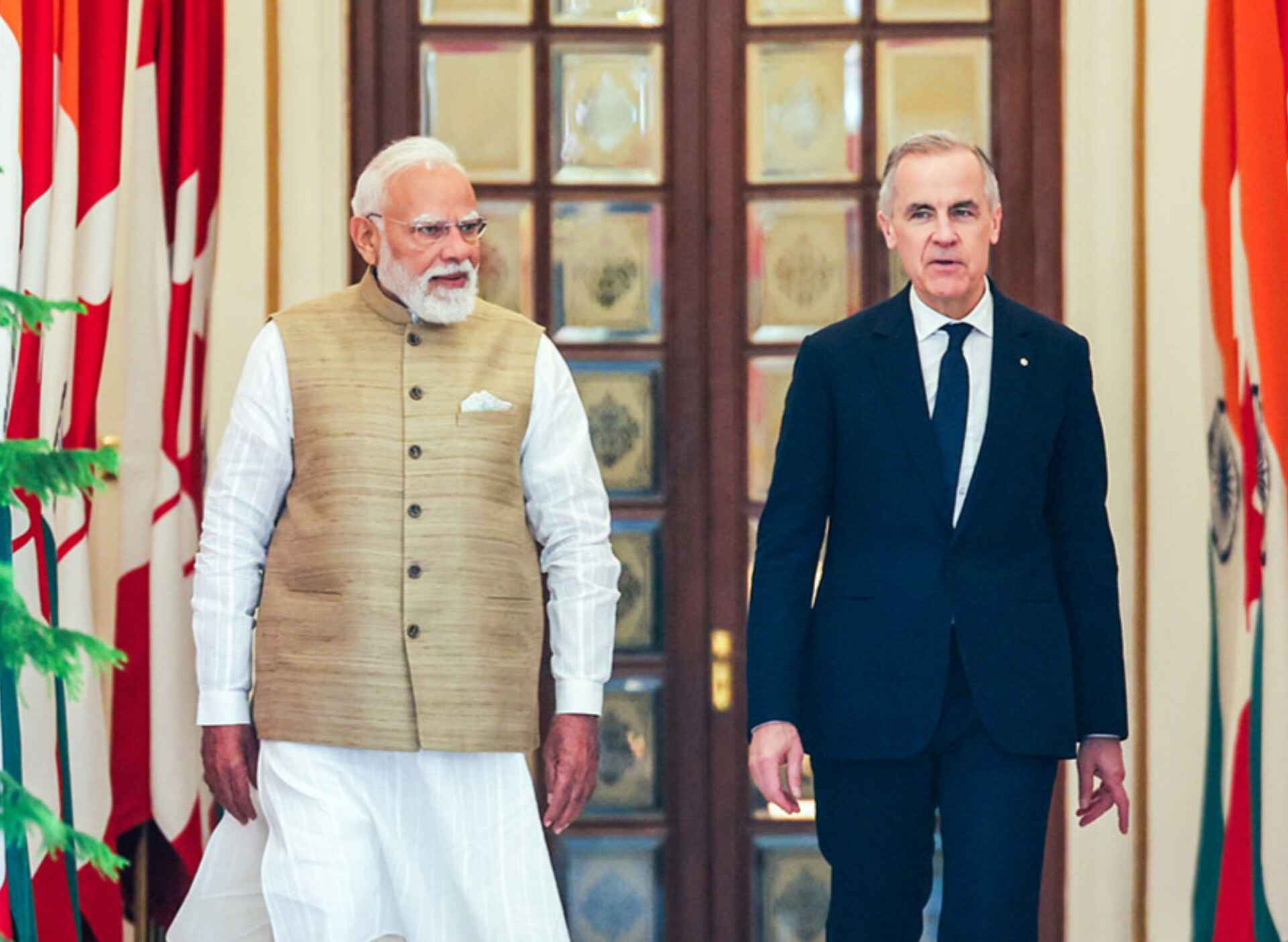
Prime Minister Narendra Modi on Monday stressed that terrorism, extremism and radicalization are common and serious challenges not only for India and Canada but for the entire world. He said that close cooperation between the two countries is extremely important for global peace and security.
He made these comments during a joint press conference with Canadian Prime Minister Mark Carney in the national capital on Monday.
PM Modi said, “We agree that terrorism, extremism and radicalization are common and serious challenges not only for both countries but for the entire humanity. Our close cooperation against them is extremely important for global peace and stability. India’s position is clear regarding the various challenges facing the world. We have always called for maintaining peace and stability. And when two democracies stand together, the voice of peace becomes even stronger.”
These comments come after tensions in India-Canada relations arose during the tenure of former Canadian Prime Minister Justin Trudeau. Diplomatic tensions between the two countries further escalated in 2023 when India expressed concern over Canada’s alleged softness towards Khalistani separatist elements and former Canadian Prime Minister Justin Trudeau alleged that Indian agents were involved in the killing of NIA-designated terrorist Hardeep Singh Nijjar outside a gurudwara in the same year.
India had vehemently rejected these allegations, calling them “politically motivated”.
Earlier, Canada’s premier intelligence agency, the Canadian Security Intelligence Service (CSIS), had officially acknowledged that Khalistani extremists are using Canadian soil to promote, fund and plan violence in India. In its annual report released last June, CSIS outlined some of the key concerns and threats to Canada’s national security.
“Khalistani extremists continue to use Canada as a base to instigate, fund or plan violence, primarily in India,” the report by Canadian intelligence agency CSIS clearly states.
This positive development between the two leaders comes at a time when India has been raising concerns about Khalistani extremists operating from Canadian soil for many years.
Prime Minister Modi thanked Prime Minister Carney for his deep commitment and vision towards India and appreciated the growth in relations with Canada under the leadership of Prime Minister Mark J Carney, saying that the two countries aim to deepen their economic cooperation with the aim of achieving a trade of US$ 50 billion by 2030. In this regard, he further informed that Ottawa and New Delhi have decided to finalize a Comprehensive Economic Partnership Agreement in the near future.
Prime Minister Modi said, “Today we discussed transforming this vision into a next-level partnership. Our target is to achieve trade of $50 billion by 2030. Tapping the full potential of economic cooperation is our priority. Therefore, we have decided to finalize a Comprehensive Economic Partnership Agreement soon.”
He said later in the day the leaders would also meet members of the business community, whose suggestions would help formulate a framework for economic cooperation between the two countries.
On the invitation of Canadian Prime Minister Narendra Modi, the Prime Minister of Canada reached India on an official visit on 27 February.
This is Carney’s first official visit to the country, which started with his arrival in Mumbai. He will leave India today after his programs in the national capital.
Starting the next leg of his official visit to India, the Canadian Prime Minister arrived in the national capital on Sunday evening after concluding a successful visit to Mumbai.
The visit comes at an important juncture in the normalization of India-Canada bilateral relations, and discussions expected on Monday will focus on key strategic and economic issues of mutual interest between the two countries.