
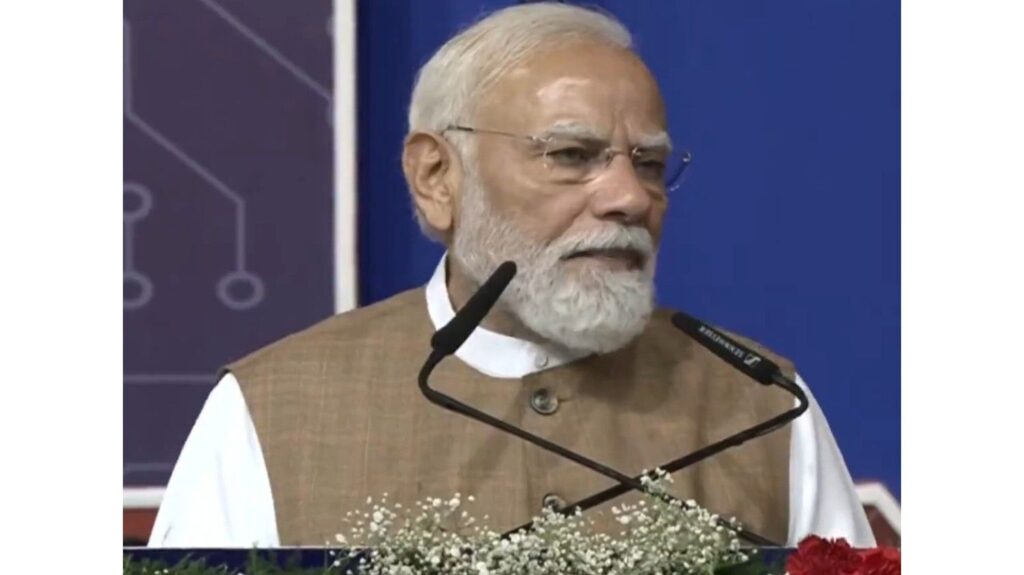
Prime Minister Narendra Modi on Tuesday inaugurated the Keynes Technology Semiconductor plant in Sanand, Gujarat, marking the beginning of production at the plant. Emphasizing the progress in India’s semiconductor sector, the Prime Minister said he was present in Sanand on February 28 to mark the commencement of production at the Micron plant and returned exactly a month later for Keynes’ achievement.
Prime Minister Modi said, “This is not just a coincidence, it is a testament to how fast India’s semiconductor ecosystem is developing.” Congratulating the leadership of Keynes Technology, the Government of Gujarat and all employees of the plant, the Prime Minister expressed pride that an Indian company has entered the semiconductor chip manufacturing sector.
Highlighting that CANs has now become part of the global semiconductor supply chain, Prime Minister Modi said, “This is a great start. In the coming days, many Indian companies will provide a stronger semiconductor supply chain to the world through global collaboration.” The Prime Minister said that today’s achievement reflects the true meaning of the mantra of ‘Make in India, Make for the World’.
According to a press release, the facility supplies intelligent power modules to a California-based company and a major portion of its production has already been booked for export. The Prime Minister said that this has created a new bridge between Sanand and Silicon Valley. Prime Minister Modi stressed, “The modules made in Sanand will reach American companies and from there will provide electricity to the entire world.”
The Prime Minister underlined the strategic importance of the intelligent power modules being manufactured at this plant, saying that these will strengthen the electric vehicle ecosystem and heavy industry both in India and globally. He described global partnerships as the foundation of a better future for the world. “It is not just about a product, but about India becoming a reliable semiconductor supplier in the global market,” the Prime Minister said.
Reflecting on the challenges faced in the current decade, from the pandemic to geopolitical conflicts, the Prime Minister said global supply chains, especially in the chips, rare minerals and energy sectors, have been hit the most. Emphasizing that disruption in these supply chains hinders the progress of all humanity, Prime Minister Modi said, “The movement of a democratic country like India in this direction is extremely important for the development of the entire world.”
The Prime Minister reminded that the resolution to make India a global semiconductor hub was taken during the COVID pandemic itself, which resulted in the launch of the India-Semiconductor Mission in 2021.
Explaining that self-reliance in semiconductors leads to self-reliance in sectors like aluminium, electric vehicles, clean energy, defense and electronics, Prime Minister Modi stressed, “This mission is not just an industrial policy, but it is a declaration of India’s self-confidence.”
Giving a detailed account of the progress of the Mission, the Prime Minister said that work is going on on 10 projects worth more than Rs 1,60,000 crore in six states, in which CANES and MICRON projects are playing an important role. He also highlighted the development of indigenous Dhruv 64 microprocessor, which provides a secure processor platform for 5G infrastructure, automotive electronics and industrial automation. Prime Minister Modi said, “India is developing the capability to design and manufacture at every level of the semiconductor value chain.”
Announcing the next phase of India’s semiconductor ambitions, the Prime Minister talked about the India-Semiconductor Mission 2.0 introduced in this year’s Union Budget. Focusing on domestic production of semiconductor equipment and materials, this new phase aims to build a full-fledged Indian semiconductor ecosystem. Prime Minister Modi said, “Our effort now is to create an ecosystem through which we can establish major partnerships in domestic and global supply chains.”
The Prime Minister highlighted India’s efforts to build a future-ready workforce and said that the target of training more than 85,000 design professionals will be achieved very soon. He also talked about the ‘Chips to Startups’ program, under which modern design tools have been made available to about 400 universities and startups, resulting in the design and manufacturing of more than 55 chips.
Prime Minister Modi stressed, “Technology development and skilled workforce must go hand in hand, India is ensuring both.” Citing industry estimates, the Prime Minister said India’s semiconductor market is currently worth about US$ 50 billion and is expected to cross US$ 100 billion by the end of this decade.
Noting the immense enthusiasm in India’s semiconductor sector, Prime Minister Modi commented, “Our aim is to manufacture the maximum number of chips for our needs right here in India.”
The Prime Minister talked about the parallel efforts being made by India to ensure robust raw material supply chains, including India’s membership in Pax Silica and the launch of the National Critical Mineral Mission. He highlighted the announcement of a Rs 1,500 crore scheme for mineral recycling and the rare earth corridor connecting coastal states like Odisha, Andhra Pradesh, Tamil Nadu and Kerala. “It would have been better if this work had started 30-40 years ago, but India is now working on it in mission mode,” Prime Minister Modi said.
Describing this decade as India’s decade, during ‘Technade’, the Prime Minister emphasized that the present era is not only about economic competition but also about shaping the technological scenario of the future. He cited India’s leadership in AI adoption, the success of Digital India and FinTech, and the recently held AI Impact Summit as evidence of Indians’ trust in and adoption of the technology. Prime Minister Modi said, “The development of our semiconductor sector will greatly strengthen India’s AI ecosystem.”
The Prime Minister emphasized that 21st century India is not just witnessing change, but is determined to lead it. He cited landmark policy decisions, such as opening up the space sector to private companies through IN-SPACE, the historic Peace Bill in the nuclear sector and mission-mode investments in quantum computing, saying these steps are laying the foundation for technology and energy security for decades to come. “India is making unprecedented investments and reforms in every critical technology sector, making it a tremendous opportunity for investors across the world,” Prime Minister Modi said.
The Prime Minister expressed confidence that the products produced from the Keynes plant will further help in establishing India as the world’s leading factory. He reiterated the government’s commitment to continuously improve ease of doing business, ease of manufacturing and ease of logistics. He wished all the best to everyone associated with the project.