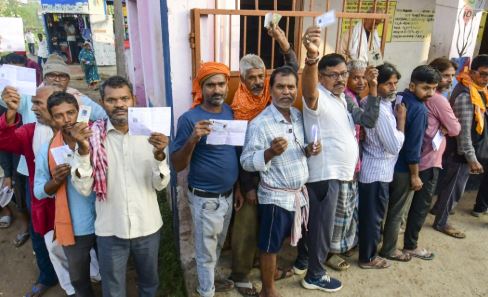
In the first phase of assembly elections in Bihar, about 65 percent voters exercised their franchise on 121 seats, which is the highest voting percentage so far in the electoral history of the state. This historic voting has brought to a decisive juncture the battle of ‘good governance versus jobs for all’ between the National Democratic Alliance (NDA), which has been in power for almost 20 years, and the opposition ‘India’ alliance.
The Election Commission said in its statement, “The highest turnout in the history of Bihar was 64.66 percent and the voting was conducted in a peaceful and festive atmosphere in the entire state.”
The NDA, which has been in power for the last two decades (barring a few intervals), is banking on its record of ‘good governance’ and development, while Tejashwi Yadav, leading the Rashtriya Janata Dal (RJD)-Congress alliance, is trying to woo the public on his promise of ’employment to every household’ along with issues like unemployment and inflation.
These elections being held for the 243-member Assembly of Bihar are being considered as an indicator of local politics as well as public inclination before the general elections of 2029. The elections are being held after the Special Intensive Revision (SIR) of the disputed voter list, over which the opposition had accused the Election Commission of “rigging” and “disruptions in the voter list”.
Let us tell you that after the first phase, the second and final phase will be held on November 11, while the counting of votes will be done on November 14.
A total of 1,314 candidates are in the fray in the first phase, including RJD chief ministerial candidate Tejashwi Yadav, state deputy chief minister Samrat Chaudhary and several ministers including Vijay Kumar Sinha. Although voting was mostly peaceful, sporadic incidents of violence were reported at some places, including an alleged attack on the vehicle of Deputy Chief Minister Vijay Sinha.
Prime Minister Narendra Modi said in the meetings organized in the constituencies of the second phase that the presence of women in large numbers at the polling stations is a good sign for the NDA. He said, “Mothers, sisters and daughters have been the biggest victims of ‘Jungle Raj’. Today they are standing like a protective shield around the polling stations so that ‘Jungle Raj’ does not return.
The NDA is hopeful that Chief Minister Nitish Kumar’s ‘good governance’ along with recent welfare schemes like 125 units of free electricity, Rs 10,000 cash assistance to over one crore women and increase in social security pension, will help in reducing the anti-incumbency wave.
At the same time, the opposition claims that the public is now in the mood for change. RJD chief Lalu Prasad Yadav wrote in an emotional post on social media platform ‘X’, “If the roti is not turned on the pan, it gets burnt. Twenty years is a very long time, now a Tejasvi government is necessary so that Bihar gets a new direction.” During the voting, a round of allegations and counter-allegations continued from both the alliances.
Deputy Chief Minister Sinha alleged that his vehicle was attacked by RJD supporters in Lakhisarai and an attempt was made to intimidate voters from backward classes. RJD, on the other hand, alleged that voting was “deliberately slowed down” in areas where the ‘India’ alliance is in a strong position, a charge immediately rejected by the Commission.
Political strategist turned leader Prashant Kishor’s ‘Jansuraj’ party is also in the fray. He has promised to make the state among the “top developed states” of the country and has also made bold announcements like ending the prohibition law.
As always, the politics of Bihar is also influenced by caste equations. Yadav, Kushwaha, Kurmi, Brahmin and Dalit voters can play an important role in deciding the outcome of many seats.