
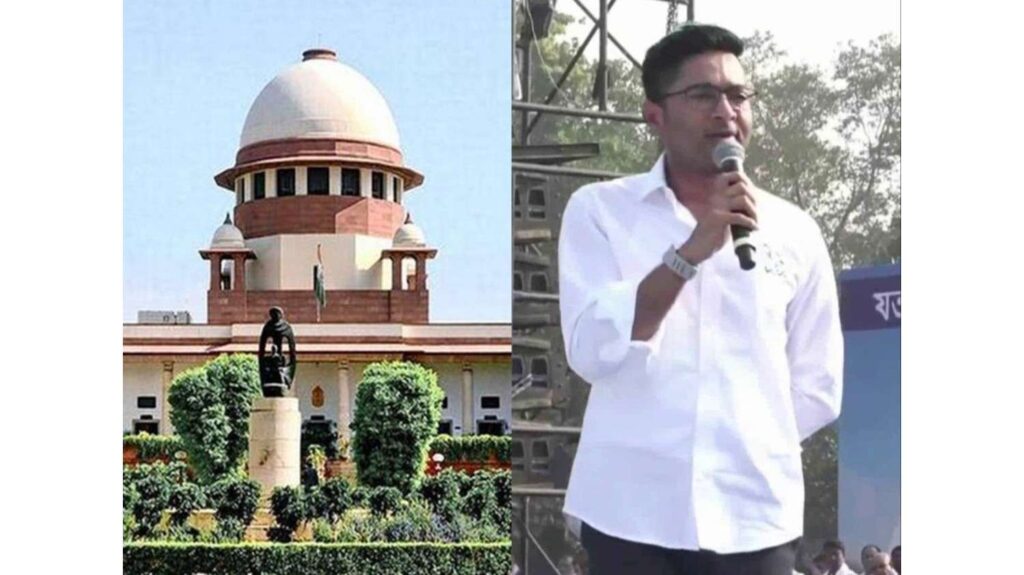
The Trinamool Congress (TMC) on Monday welcomed the Supreme Court’s decision directing the Election Commission of India (ECI) to display the names of voters falling in the category of ‘logical anomalies’ in the ongoing Special Intensive Revision (SIR) of voter lists in West Bengal.
While TMC welcomed the decision, the opposition party in West Bengal said the Supreme Court’s directions cannot be seen as a victory for Chief Minister Mamata Banerjee’s party.
A three-judge bench headed by Chief Justice Surya Kant issued directions to the ECI on various petitions alleging procedural irregularities in the SIR process in West Bengal. The Supreme Court noted that the ECI has issued notices to some persons who have been categorized as having ‘logical anomalies’.
Hence, with a view to enable the persons included in this category, the Court issued directions to publish the names of such persons in Gram Panchayat buildings, block offices and ward offices.
The Court directed the State Government to provide adequate manpower to the Election Commission and the State Election Commission to consider the documents and objections and to follow the hearing process for the affected persons. In this regard, instructions should be issued by the Election Commission/State Government for deployment of adequate personnel.
Persons likely to be affected will be allowed to present their documents before authorized officials. The Supreme Court directed to issue an authorization letter in this regard. The bench directed those persons in this category who have not yet submitted their claims and objections to do so within 10 days.
West Bengal Governor CV Anand Bose welcomed the directions, calling the reforms necessary for democracy. He said, “We welcome the Supreme Court’s decision. Medium-term reforms are especially necessary in a developing democracy. This can be considered a part of India’s evolution towards a mature democracy.”
The Electoral Roll Officers Network (ERONET) portal had flagged over 1.2 crore names under the ‘logical anomaly’ category, sparking a fresh controversy over the SIR exercise in the state. TMC MP Kakoli Ghosh Dastidar described the decision as a “slapping slap” on the “atrocities” committed by the Election Commission. He said, “This is a slap on the atrocities being committed on the people of West Bengal by the Election Commission on the instructions of the BJP.”
“We welcome the Supreme Court’s decision and thank the court for this decision,” he said. TMC MP and senior advocate Kalyan Banerjee said the court wants transparency in the SIR process and will “intervene” if the process remains opaque.
However, BJP leader Rahul Sinha said that unlike TMC, BJP accepts all the decisions of the court. “This is not their victory. The Supreme Court has given its observations, which apply to everyone and everyone agrees with it. We respect courts and democracy. We respect court orders, whether they are in our favor or not; only then will democracy survive. We are not the Trinamool Congress which disrespects courts, agencies and the central government,” he said.
Meanwhile, amid the ongoing controversy over the SIR process in the state, a clash broke out between TMC and BJP supporters over submission of Form 7 outside the Lalbagh SDO office in Murshidabad.
BJP alleged that TMC MLA Asit Majumdar tore Form 7 in the SDO office. BJP shared a video on
However, Majumdar denied these allegations. Speaking to reporters in Hooghly, he said, “This is a lie. Have you seen me tearing it?” Assembly elections are going to be held in West Bengal later this year, due to which the politics of the state has heated up.
Although the SIR process has become a point of contention between the two parties, the deadline for filing claims and objections (adding new voter names through Form 6, deletion through Form 7 and correction through Form 8) has been extended from January 15 to January 19, giving voters additional time to submit their applications. The hearing on these claims and objections will continue till February 7, 2026. The final voter list of West Bengal will be published on February 14, 2026.