
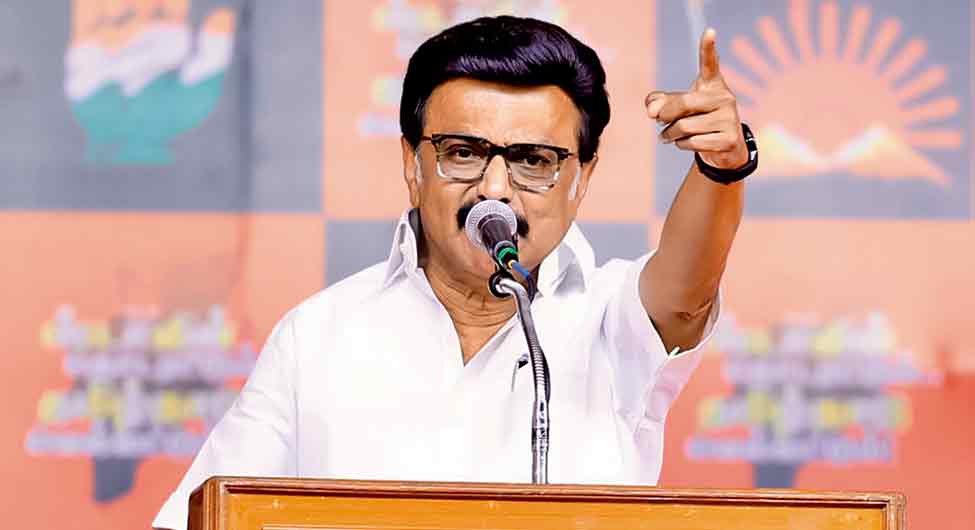
Chief Minister M.K. Stalin succeeded in presenting the election fight as ‘Dravidian’ versus his ideological opponents.
Till that time, the excesses of Soviet leader Joseph Stalin’s era had not been fully exposed to the world. Later, the world was shocked by Nikita Khrushchev’s revelations. By then Stalin had remained a great hero throughout the world, especially among anti-imperialist-fascist forces. After Stalin’s death on March 5, 1953, young and energetic M. Karunanidhi was among the key speakers in front of the huge crowd gathered at the memorial meeting at Marina Beach, Chennai. In his emotional speech, Karunanidhi announced that he would name his newborn son Stalin, who was born on March 1, in memory of the great leader.
This is how the story of Muttuvel Karunanidhi Stalin began. He is now trying hard in the field to get a second term as the Chief Minister of Tamil Nadu. M.K. Stalin started political activism at the age of 14. Despite being the son of M. Karunanidhi, one of the most influential leaders of Tamil Nadu, he had to wait a long time to become the Chief Minister of one of the most economically and socially developed states of the country. Today Stalin is walking on such a political path, on which the founding leaders of his party, C.N. Annadurai and M. Karunanidhi had also never stepped forward.
Over the past five years, as Chief Minister of Tamil Nadu and leader of the strong regional power Dravida Munnetra Kazhagam (DMK), Stalin has become a symbol of opposition to the NDA government at the Centre. Stalin alleges that the central government attaches political conditions to fund transfer. They call this “economic strangulation” of the states.
For Stalin and his party, this struggle is not just a political contest, but a fight to save the federal balance of the country, which is deeply rooted in the ideological foundation of the Dravidian movement.
Stalin’s supporters with posters
As the Bharatiya Janata Party (BJP) expands across the country, Stalin and the DMK position themselves as ideological bulwarks against the “advanced juggernaut of the Sangh Parivar”. They consider it a big challenge. He is also a vocal critic of the National Education Policy 2020. They argue that this weakens federal principles and poses a threat to the linguistic and cultural diversity of states like Tamil Nadu.
Tamil Nadu has strongly opposed the Central Government’s proposal of ‘One Nation, One Election’ and its plan to delimit constituencies based on the new census data. The Tamil Nadu Assembly passed a resolution saying that both these proposals are contrary to the basic spirit of the Constitution and may harm the federal balance at the Centre.
Opposition to delimitation is particularly sharp because of fears that states that have successfully controlled population growth may lose representation or numerical strength in Parliament. However, after the increasing uproar, Union Home Minister Amit Shah has said that the Lok Sabha seats of the southern states will not be reduced after delimitation.
Stalin met former Governor R.N. The confrontation with Ravi also turned into a major constitutional dispute. Stalin approached the Supreme Court against keeping the approval of bills passed by the Assembly on hold. In a historic decision, the court set a deadline for governors to act on bills passed by the Assembly. This decision sparked widespread constitutional debate and ultimately led to the President sending a reference to the Supreme Court seeking clarification on certain aspects of the decision.Fell.
Palaniswami of AIADMK
Stalin became the Mayor of Chennai in 1996. During that time his administrative abilities were exposed and his credibility within the party was strengthened. Stalin has tried to present himself not only as a regional leader but also as the leading voice of the broader national opposition against the ideological and political agenda of the BJP. He walked step by step with Rahul Gandhi during the Bharat Jodo Yatra. He was present in Bihar at the time when there was an uproar over SIR.
Vignesh Rajamani, political scientist and author of ‘The Dravidian Way’, says, “Stalin can be compared more with CN Annadurai than with his father M. Karunanidhi. Karunanidhi ruled for a long time, but he never had to face an ideologically opposing government at the Centre. Stalin, on the other hand, is facing a central government which is ideologically the complete opposite of the DMK.”
In the last five years, these battles have given Stalin a unique identity and have created his image as a leader who has consistently challenged the central government and also raised issues related to federalism and states’ rights. Congress MP from Mayiladuthurai R. Sudha says, “Stalin has emerged as a national leader who can take on the BJP because of his ideological commitment. He has raised the level of state politics.”
Unlike many heirs of great leaders, it has not been easy for Stalin to take over the reins of DMK. He came forward at a time when there was discord between the family and the party and there was turmoil in the politics of Tamil Nadu.
He is the son of Karunanidhi and his second wife Dayalu Ammal. He entered politics at a young age by campaigning for his uncle Mursoli Maran. However, his first major recognition came during the anti-Hindi movement of 1967, which brought DMK to power in the state.
But Stalin was put in jail during the Emergency. The Central Government had dismissed the Karunanidhi government accusing it of corruption. This turmoil brought film star-turned-politician M.G. It also prepared the ground for Ramachandran’s rapid rise. He separated from DMK and formed his own party named All India Anna Dravida Munnetra Kazhagam (AIADMK). The DMK remained largely marginalized in Tamil Nadu politics until MGR’s death.
>
According to Vignesh Rajamani, author of ‘The Dravidian Way’, Stalin should be compared to C.N. Karunanidhi rather than his father M. Karunanidhi. More can be done than Annadurai
In that uncertain period, Stalin also tried his luck in films for some time, but he did not get success there. In 1989, the political winds changed. DMK returned to power with an overwhelming majority. Stalin won the election from Thousand Lights seat of Chennai. By then his elder brother M.K. Alagiri was sent to Madurai to expand the party, allowing Stalin to be closer to his father. His father was the Chief Minister at that time. Stalin won the elections from the Thousand Lights assembly constituency four times and gradually emerged as the ‘real heir’ of the party, while Alagiri also remained a frequent contender to take charge of the party.
In the words of a senior DMK leader present at the party headquarters, Stalin’s tenure as mayor of Chennai in 1996 helped him cement his ‘number two’ status within the organisation. As Mayor, Stalin initiated many development works aimed at modernizing and beautifying Chennai, due to which he came to be known as “Managara Tantai” (Father of the City).
When Stalin took over the reins of the party after the death of Karunanidhi, he also took along senior leaders of his father’s era and T.R. Important responsibilities were handed over to personalities like Balu and Duraimurugan. But the politics of Tamil Nadu was not easy at all.
J. Jayalalitha’s aggressive style had created problems for both Karunanidhi and Stalin. Karunanidhi himself was dramatically arrested in a corruption case during the AIADMK government, which shocked the entire nation. Around the same time, Stalin was embroiled in a family feud with his elder brother Alagiri. The conflict came to a head when Alagiri was arrested in connection with the murder of a close associate of Stalin.
Stalin was made Deputy Chief Minister under Karunanidhi in 2009 after the DMK returned to power. He used this tenure to increase his reach among the public and gradually consolidate his position as the de facto leader of the party. Former MP and DMK leader R.S. “When Kalaignar (Karunanidhi) passed away, everything became easier,” says Bharathi. Then he did not look back. I have seen him rise from being a common worker in the party to this position since 1967.” Vignesh Rajamani says, ”He is one of the most intellectual leaders of the country’s politics today.”
Second innings: Stalin’s popularity has no match in Tamil Nadu
His political acumen was evident during the talks with Congress on seat sharing in these elections. A section within the Congress was pushing for a break with the DMK and exploring the possibility of an alliance with actor-leader Vijay’s new party Tamilaga Vetri Kazhagam (TVK). Despite this, Stalin kept the Congress firmly in the DMK-led alliance and did not yield much to its demands. He also succeeded in bringing several other political forces into the fold of the alliance, including late actor Vijayakanth’s party Desi Murpokku Dravida Kazhagam (DMDK).
This massive effort to build an alliance shows that Stalin gives more importance to strengthening a broad opposition front than increasing his party’s immediate electoral share, even if this means the DMK has to contest on fewer seats. MP and VCK leader D. Ravikumar says, “Stalin is a great worker, a struggler and a much-loved leader.”
The constant political tension with the central government, revival of the core issues of Dravidian ideology and lack of leadership in the rival party AIADMK have proved helpful in Stalin’s rising stature. The next generation of the family has also taken over important roles. Udhayanidhi is the Deputy Chief Minister, step sister Kanimozhi has emerged as one of the national faces of the party. That’s why DMK’s opponents often accuse him of dynastic politics.
However, Stalin has succeeded in presenting the political battle in Tamil Nadu as a battle between ‘Dravidism’ and its ideological opponents. Experts say that his political wisdom is still leaving a deep impression among a large section of voters in Tamil Nadu.