UDF led by Congress and LDF led by CPI(M) face each other in the battle of Kerala, accusing each other of secretly colluding with BJP.
Radha Lakshmi, a daily wage laborer living in Walayar, a small town in Kerala on the Tamil Nadu border, is a staunch supporter of the CPI(M). So, she considers both Congress and BJP as her opponents. He is aware of the news from just across the border, where his party and the Congress are fighting together against the AIADMK-led NDA in Tamil Nadu. She says, “There is nothing wrong in this. Here in Kerala, the situation is different. Our main fight is with the Congress.” For activists like Radha Lakshmi and also for the top leadership of the party, Congress is the main rival. It is necessary for the Congress to defeat the CPI(M) in Keralam. Interestingly, both the parties have made the accusation of secret collusion with the BJP against each other the main issue of the election campaign. Their basic objective is to claim to be the protectors of secularism. In the race to outdo each other.
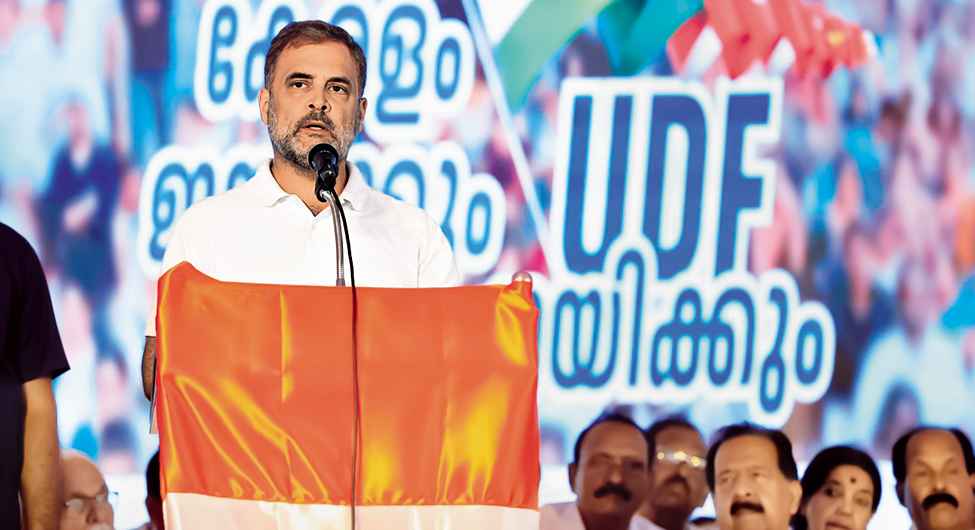
When Congress President Mallikarjun Kharge visited Kozhikode for a UDF rally, he launched a scathing attack on the CPI(M) and the BJP over their alleged common political interests. Rahul Gandhi said that for the sake of his children, Chief Minister Vijayan has leaned towards Modi-Shah. These comments drew a strong reaction from the CPI(M) Politburo, making it clear that regional political compulsions have deepened the gap between the country’s two most prominent secular political factions.
Vijayan in the district committee office of Malappuram.
Senior journalist and commentator PT. Nassar says, “There has always been a fight here between the CPI(M) led front and the Congress led front. What has changed now is that with the emergence of the BJP, both these fronts are eager to present themselves as the main bulwark against Hindutva forces.”
In 1991, in two constituencies, Vadakara Lok Sabha constituency and Beypore Assembly constituency, the Congress-led UDF and the BJP had shared support for independent candidates against the Left. This is perhaps the first and only instance in Kerala when Congress and BJP supported the same candidate against their common rival.
Late K.G. Marar wrote in his memoir that there was an agreement between the two parties to extend support in other constituencies as well. This arrangement did not benefit the BJP electorally, as none of its candidates could win. The subsequent revelations of Marar left a deep mark in the political discourse of Kerala, which is still mentioned in contemporary debates.
Earlier, in the post-Emergency era, Congress had alleged that the CPI(M) and the Jan Sangh, the former form of the BJP, had worked together under the Janata Party banner to contest the 1977 elections. In the years that followed, the BJP gradually expanded its vote share in Kerala. The party achieved major success by winning its first assembly seat in the state in 2016 and also opened its account in Parliament from Kerala in the 2024 Lok Sabha elections.
Keralam is a state where about 46-48 percent of the population belongs to minority communities, which include Muslims (about 28 percent) and Christians (about 20 percent).
P.T. Nassar says, “This composition of the population is the main obstacle in the way of the BJP. In the last Lok Sabha elections, the party had managed to make inroads among a large section of Christian voters. But in view of the results of the local body elections, it seems that the Congress has regained that support to a great extent.”
Narendra Modi in Palakkad public meeting
The result is a familiar political rivalry: both the UDF and the LDF accuse each other of secretly colluding with the BJP. Every party tries to present itself as a more credible secular force, so as to win over minority votes. Chief Minister Pinarayi Vijayan and Opposition leader V.D. Satheesan is alleging that the other has a past history of association with the BJP.
BJP Secretary M.T. Ramesh says, “The real contest is between Congress and CPI(M). Last time there were chances of BJP winning in Manjeshwar and Palakkad constituencies, CPI(M) cross-voted in favor of UDF to ensure BJP’s defeat. Even after doing so, these two parties continue to accuse each other and even the BJP of having a secret arrangement.”
However, opposition leader V.D. Satheesan, in response, alleges that the BJP avoided fielding strong candidates in some constituencies where it has a higher vote-share and instead left those seats for organizationally weaker NDA allies. He says, “The CPI(M)’s objective is to defeat the UDF and indirectly help the BJP. The CPI(M) has fielded a non-political face in constituencies like Palakkad, where the BJP has emerged as a strong second force. In some important constituencies too, they have left the field to allies.”
But some political experts believe that these allegations and counter-allegations are unlikely to have much impact on voters’ choices. Dr Kuttikrishnan, who has written a book on the electoral history of Kerala, says, “These allegations are not new, but now they have come into focus. In many ways, it is a ploy to divert voters’ attention from the more important issues in the election.” In the last Lok Sabha elections, the BJP had its best-ever performance in the state. It not only won the seat for the first time, but also gained lead in 11 assembly constituencies. The party’s vote share exceeded 16 percent, which is its highest ever vote share in Kerala. The main seats on which BJP is trying its best include Manjeshwar (an area bordering Karnataka), Palakkad and Nemom. All these seats are considered important for the party’s expansion strategy in the state. Due to national leaders like Rahul Gandhi and Mallikarjun Kharge raising these allegations loudly and CPI(M) giving a sharp reply to these allegations, the development agenda of the Left parties has currently been left behind.
It remains to be seen how much this narrative will translate into electoral gains for any of these political parties. Yet, as a BJP leader says, whether intentionally or unintentionally, this massive barrage of allegations and counter-allegations reveals a larger truth: the BJP has now become a challenge for both the Congress and the CPI(M) that cannot be ignored. Whatever happens, the results on May 2 will tell what is the direction of politics.