
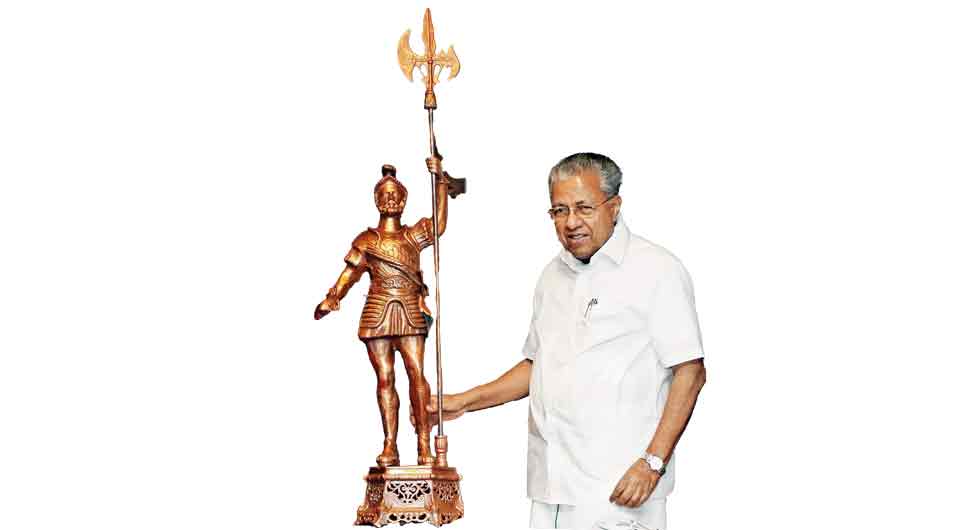
For Chief Minister Vijayan, who has played a role in Kerala politics for almost three decades, politics only means power within the party and for the party.
The incident is of March 30, 1977. The country was coming out of the long shadow of the Emergency of the then Prime Minister late Indira Gandhi. The national political atmosphere had changed completely in the general elections. During the same period also, the Congress-CPI alliance came back to power in Kerala. That day a 28 year old MLA stood up to speak in the assembly. That Communist (Marxist) or CPI(M) MLA from Kuttuparamba, a small town in northern Kerala, was a relatively unknown person. Then that scene appeared which remained forever in people’s memories. He raised the torn, blood stained shirt in his hand… then there was silence in the house. Then, he narrated the heart-wrenching story of the brutality he faced in custody after he was taken away by the police from his home during the Emergency. He met Chief Minister C. Achyuta Menon and Home Minister K. Pointing towards Karunakaran, he held the government directly responsible for this. His loud voice was echoing in the House, “This police excess has been done at the behest of the government. This is completely intolerable.”
At that tense moment, Kerala witnessed the emergence of a political leader who later left a deep mark on the state’s politics, leftist movement and governance. Pinarayi Vijayan’s subsequent journey is the story of a fighter, a spirit of not accepting defeat, and how he gathered strong support and opposition for himself with such a political style.
After five decades, Vijayan is facing his toughest political test. The CPI(M) leaders, who created history by bringing the Left Democratic Front (LDF) back to power for the second consecutive time in 2021, are now standing at a very important juncture. CPI(M) state secretary M.V. Govindan says, “Pinarai is the most important leader of the CPI(M), and he is leading the way. This is a very important election for the Left. The achievements of the last decade in welfare work and infrastructure development will prove helpful in returning the Left to power.” This election is completely dependent on Vijayan for the party and the Morcha.
Tough test: Chief Minister Vijayan releasing the manifesto in the party secretariat
But, according to the United Democratic Front (UDF), the weakest link of the CPI(M) is Vijayan himself. State Congress general secretary M. Lijo says, “Just as he has strengthened his hold on the party, allegations of nepotism and many cases of corruption will harm the CPI(M).” The opposition is pointing to the alleged strategic change that the CPI(M) has made in recent years regarding Hindutva politics. After the electoral defeat in the 2024 Lok Sabha elections, the party changed its strategy in view of the resentment, especially among some sections of the Hindu Ezhava community, which constitutes about 30 percent of the population.
In the months that followed, the government stepped up attacks on Islamic organizations, particularly Jamaat-e-Islami, and portrayed them as a communal force. Group editor of Jamaat-e-Islami-controlled Madhyam and MediaOne TV, O. Abdurrahman says, “The way the Vijayan government launched the campaign against Jamaat-e-Islami ultimately strengthened the Sangh Parivar’s arguments.” A similar change was seen in the government’s stance on the Sabarimala temple issue. Vijayan’s first government had strongly defended the Supreme Court decision which allowed women of all ages to enter the temple. But later the government indicated to the court that matters related to customs should be left to religious institutions only.
Sanskrit scholar, writer T.S. Shyam Kumar says, “This change in attitude shows that there is an attempt to adapt the issues related to social reform to religious sentiments.”
Senior journalist, former editor of Asianet News M.G. Radhakrishnan says, “Rather than sticking to Leftist principles, the government seems to prefer organizations whose interests are clearly communal. An example of this is SNDP Yogam leader Vellappally Natesan’s defense that Yogam was founded by social reformer Sree Narayana Guru. Natesan had made derogatory comments against Muslims.”
The opposition is increasing the scope of attack on him. The Congress alleges that Vijayan’s stance softened against the BJP when his daughter got embroiled in a financial controversy. After that the central agencies have slowed down the pace of investigation. In fact, the opposition also alleges that there is internal coordination between CPI(M) and BJP on some seats. UDF has made this the main election issue.
organization man
Vijayan hails from Pinarayi, a small village in Thalassery taluka, just a few kilometers away from Padapram. It was here in Kerala that the communist movement first took shape. Vijayan entered parliamentary politics when he was just 25 years old and was a local CPI(M) leader in Thalassery. But, he became famous due to two important incidents in that ‘Lal Garh’.
The first incident occurred in 1971 during the Thalassery riots. Communal tension had gone out of control. When armed gangs started creating chaos on the streets, communist leaders spread across the city. Their objective was to provide security to vulnerable minority communities and restore peace. At that time, the party’s youth worker Vijayan was among those standing at the forefront.
The second incident was more personal and also more serious. Vijayan was also made an accused in the murder of a Rashtriya Swayamsevak Sangh (RSS) worker, but the case did not hold up in court, as no evidence was found against Vijayan or other CPI(M) workers, and he was acquitted.
In that period of political mobilization, confrontation and commitment, both these incidents together enhanced Vijayan’s image in Kannur. Vijayan’s rise in the party came at a time when there was a lot of turmoil in the party. A major internal disagreement was emerging in the party. At that time, he was made the District Secretary of Kannur, which is called the ‘bastion of the Left’. Due to differences regarding political alliances, veteran leader M.V. Raghavan was expelled from CPI(M). After that incident, there was a strong need to unify and create new coordination in the party organization.
That period proved to be a turning point for Vijayan. He reached the top leadership ranks of the party in Kerala. Vijayan became a minister in the 1990s, which further enhanced his administrative abilities. But his most important role came later, when he was made the State Secretary of CPI(M). He held that post for 17 years and emerged as the most powerful leader of the party in the state. Later, as Chief Minister, he continued to shape both the party organization and its political strategy for almost two decades.
Challenge: Leader of Opposition in Congress Assembly Satheesan
Former CPI(M) minister and Central Committee member P.K. Srimati says, “I have known Pinarayi Vijayan for decades. He has led the party to overcome many challenges on the strength of discipline and strong will.” But Vijayan has not remained untouched by controversies both in his roles as party secretary and as Chief Minister. These controversies not only arose from his political opponents, but he also had to face opposition from within the leftist camp. It is alleged that Vijayan does not tolerate the voice of opposition and is promoting such leaders in the party organization who are known for loyalty.
“Vijayan has a dictatorial attitude,” says Radhakrishnan. TP accused of intolerance towards protest They rose up loudly after the murder of Chandrasekaran. CPI(M) leader Chandrasekaran later turned rebel and challenged the party’s dominance in parts of Kozhikode by forming a separate faction. Chandrasekaran was murdered in 2012. Many CPI(M) workers were held guilty in this case and there was widespread anger across Kerala. On the other hand, the controversy flared up further when Vijayan called Chandrashekharan a ‘traitor’. Chandrasekaran’s wife and now MLA K.K. Rema says, “This reflects a feeling of revenge and a dictatorial attitude.”
But state committee member and Rajya Sabha MP A.A. “The chief minister listens to different views patiently. But once a decision is taken, he makes sure that it is implemented,” says Rahim.
Vijayan’s home district Kannur had been synonymous with political violence for decades. Since the 1980s, there has been a series of revenge killings in the area, involving CPI(M) workers and those associated with the RSS-BJP network.
However, a change was seen after Vijayan became the Chief Minister. In an important initiative, talks were held between CPI(M) and RSS-BJP leaders, which was mediated by religious guru Shri M. In the years that followed, the intensity of violence in Kannur reduced significantly. Many experts linked this to that ‘backchannel’ conversation to some extent.
The Left Front government led by Vijayan laid renewed emphasis on infrastructure and other big projects. The most special among them is Vizhinjam International Seaport developed by Adani Group. It has been presented as an important achievement of the state.
When LDF came to power again in 2021, Vijayan’s complete control over the party was clearly visible. After the victory, he took a shocking and out-of-the-box decision. No minister from his previous cabinet was given a place in the government. Many senior leaders were ousted, including K.K. Shailaja was also there. Shailja’s work in the health department during the pandemic was praised everywhere. Relatively young leaders were included in their place.
Among them was Vijayan’s son-in-law P.A. There is also Mohammed Riyas, who was then the national president of the ‘Democratic Youth Federation of India’ (DYFI). He was entrusted with important departments like ‘Public Works’ and ‘Tourism’. The decision added another new dimension to the ongoing debate over allegations of leadership style, generational change, nepotism and centralization of power. Socio-political commentator Damodar Prasad says, “We have seen in the last few years that power has gradually been concentrated in the hands of a single leader. Pinarayi is seen everywhere.”
Senior journalist Kamalram Sajeev recalls that K. When Karunakaran was rebelling against the Congress, the CPI(M) under the leadership of Vijayan explored the possibility of an alliance with his faction. Sajeev recalls, “I had asked him (Vijayan) how he could coordinate with a person whose government had made him a victim of police torture during the Emergency.” Vijayan’s answer was, “That was a political act of a particular period.” This answer points to the important feature of Vijayan’s politics that in order to serve one’s own interests, the past can be set aside in view of political gains and losses.
This election season, in the huge hoardings of LDF and CPI(M) put up in towns and on highways across the state, only Vijayan is visible everywhere, and hardly anyone else. The founders and stalwarts of the leftist movement are almost absent from them. For some, this reflects authoritarian tendencies, that is, a centralization of power that mirrors emerging trends in the broader national political landscape. For others, it is a clever ‘rebranding’ of Left politics to suit the new political era.