
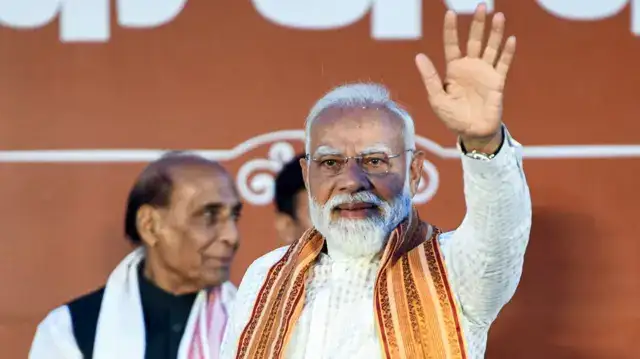
The 2026 assembly elections have emerged as a major change in the politics of West Bengal. Mamata Banerjee-led Trinamool Congress (TMC), which was in power for a long time, suffered a defeat this time that hardly anyone could have imagined. In a stellar performance, the Bharatiya Janata Party (BJP) won 207 seats in the 294-member assembly, capturing power with a clean majority. As election trends started emerging, it became clear that the political atmosphere in Bengal has changed. TMC had got a massive victory in 2021 with 213 seats, but this time its seats came down to just 80. Meanwhile, traditional parties like Congress and CPI(M) were marginalised; Congress could get only 2-3 seats, while the Left parties were limited to only 1-2 seats.
BJP did not get this victory overnight. Over the past few years, the party has steadily strengthened its hold in Bengal. Its vote share was only 10% in 2016, which increased to 39% by the 2024 Lok Sabha elections. Now, this momentum has transformed into political power in the 2026 assembly elections. However, even with its victory in Bengal, the road ahead is not at all easy for the BJP. The party now faces many challenges—severe tests that it will find difficult to pass. Since independence, the state has been known for political violence, power struggles and the rise of Naxalism. Therefore, BJP will have to face big challenges in Bengal. Let us look at the special tests that BJP will now have to pass to be successful in the state.
Will BJP be able to end ‘political violence’ in Bengal?
A dark aspect of West Bengal politics—political violence—has long been the subject of heated debate. For decades, the state has faced allegations that governments in power have either ignored such violence or, in some cases, tacitly encouraged it. Many times the situation has become so bad that people have even lost their lives just because of the suspicion that they have voted or supported some other political party. In such a situation, if BJP comes to power in the state or strengthens its hold, then one of the biggest challenges for it will be to decide how to control the increasing violence with political help. Strengthening law and order, enforcing laws without discrimination, and regaining people’s trust—tackle these issues will be no easy task, yet it will be vital.
Will atrocities against women stop in Bengal with the coming of BJP government?
Bengali society is often known for its progressive outlook and ‘bhadralok’ culture—an environment where women’s participation and status in society is generally considered strong. However, this is only one aspect of reality. On the other hand, in the same state—especially in rural areas and areas along the international border—the reality seems much scarier. There are often reports of sexual harassment, gang rape and other heinous crimes against women from these areas. These incidents not only raise serious doubts about the state of law and order, but also expose a section of the society where security and justice remain big, unresolved challenges.
R.G. A female doctor brutally attacked in a hospital: a clear example
R.G. The recent case of gang rape and murder of a female doctor at Kar Medical College and Hospital is a clear, recent example of this grave social ill. Such incidents clearly show that women’s safety cannot be limited to cities only; Rather, it must be actively paved and secured at the grassroots level.
Therefore, if the BJP comes to power in the state – or tries to consolidate its political hold – one of its biggest challenges will be to implement concrete and effective measures to ensure the safety of women. Strengthening the law and order machinery, ensuring that criminals are punished severely, and guaranteeing justice to victims – all these aspects will undoubtedly emerge as top priorities for the party.
Will infiltration in Bengal stop if BJP comes to power?
On the evening of May 4—after the BJP’s election victory in West Bengal—when Prime Minister Narendra Modi addressed the public, a particular part of his speech caught special attention and became the center of conversation. He clearly said that now strict action will be taken on the issue of infiltration. From this statement it was not difficult to understand how important and effective this issue has become in the politics of Bengal. In fact, the election results clearly showed that the question of infiltration remained an important election issue for the BJP. The party took up this matter.
Behind Bengal, Maharashtra and Gujarat
The economy of Bengal has suffered a severe blow due to decreasing employment opportunities and slow pace of development. While states like Maharashtra and Gujarat made rapid industrial and economic progress, West Bengal remained mired in political instability and economic stagnation for a long time. Its effect is clearly visible in the infrastructure and working methods of the state. Now the time has come to change this situation. The biggest challenge before both the Central and State governments is to bring the pace of development back on track and create new opportunities for the people. If Bengal once again gets back on the path of growth, it would be a huge achievement not only for the state, but for the entire country—and could prove to be an important step towards realizing the dream of a developed India.