
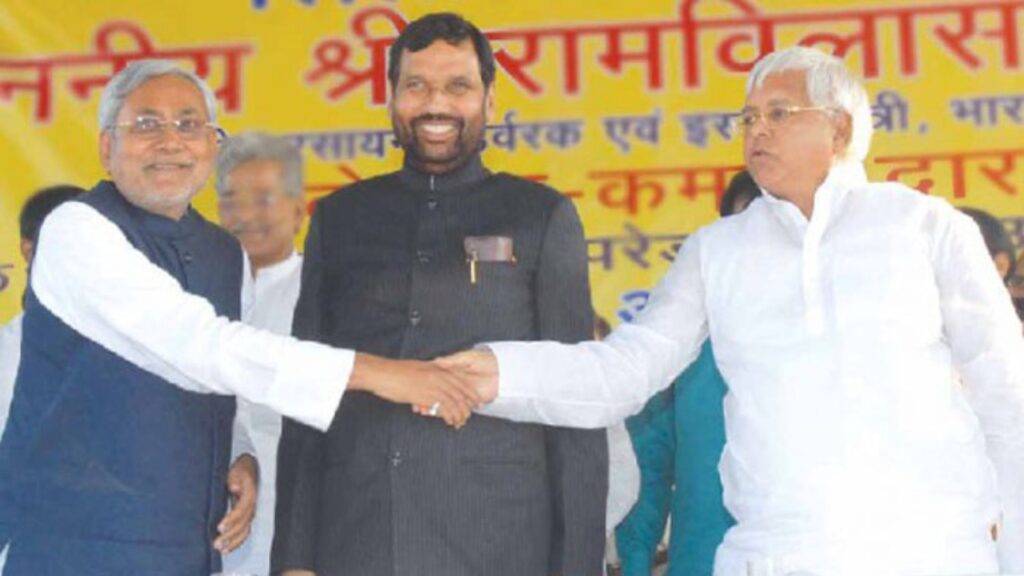
The month of February 2005 brought a storm in Bihar politics, whose echo was heard not only in the corridors of power, but in the political discourse of the entire country. The election results came, but the government did not form. More than the results, this election is remembered for the crisis created after that, due to which the Chief Minister of Bihar should be a Muslim of Bihar, an extraordinary and unexpected condition of Lok Janshakti Party leader Ram Vilas Paswan. This one demand not only stopped the formation of government, but also gave rise to instability in the state, which results in dissolving assembly and re -election within six months.
The election results on 27 February 2005 did not give a clear majority to any party or coalition. RJD, who contested the election under the leadership of Lalu Prasad Yadav, became the largest party with 75 seats, but the figure was far from the majority. The total seats of UPA, including 18 seats of Congress, were only 93. At the same time, NDA got 92 seats. But the real shocking figure was Ram Vilas Paswan’s LJP, who won 29 seats on its own and took the key of power in his hands.
This was the turn from where Bihar politics took an unexpected turn. Everyone hoped that Paswan could either go with the UPA or join hands with the NDA. But the condition he laid, he surprised all political analysts. Instead of becoming the Chief Minister, Paswan himself demanded that the Chief Minister be made a Muslim. This was the first time in political history when a party did not stake its claim for the highest chair of power, and said that he should also support someone else on the condition of being from a particular community.
His strategy behind this demand of Ram Vilas Paswan was deep. He had created his image as a friend of minorities after the Gujarat riots and he felt that he had the moral right to lead Muslims. Lalu Yadav’s M-Y (Muslim-Yadav) equation dominated Bihar politics for decades. Paswan wanted to raise the DM (Dalit-Muslim) equation by challenging this equation, hoping that he could become the new socio-political axis of the state.
He even proposed that the Chief Minister should be from RJD, but a Muslim leader such as Zabir Hussain should be made. Lalu Prasad Yadav was uncomfortable with this condition. He feared that if the command of the government went to someone else, both the party and the power would get out of their hands, especially when the pressure on them was constantly increasing on the fodder scam.
On the other hand, the NDA, especially BJP, had flatly denied this demand of Paswan. The BJP did not agree with the view of a Muslim Chief Minister, and without the consent of the BJP, JDU could not form any government. In such a situation, both alliances, denying the condition of Ram Vilas, pulled back from the formation of the government.
Amidst political deadlock, dissatisfaction also started to flourish among his MLAs of Ram Vilas Paswan. The legislators had huge resources to win the election and wanted a stake in the government. He wanted Paswan himself to demand to become the Chief Minister, but Paswan stayed on his condition. As a result, LJP started to break up and many of its MLAs joined JDU. Although the number was not enough that the government could be formed, it caused a deep injury to LJP’s solidarity.
Seeing the situation deteriorating continuously, Governor Buta Singh recommended President’s rule and on 7 March 2005, President’s rule was implemented in Bihar. When there was no possibility of forming a government, the assembly was eventually dissolved on 23 May and a new election was announced.
Bihar voted again in October 2005, but this time the picture had completely changed. LJP, who played the role of a kingmaker until a few months ago, was reduced to just 10 seats. On the other hand, JDU and BJP alliance led by Nitish Kumar won a majority and Nitish Kumar became the Chief Minister of Bihar.
The condition of Ram Vilas Paswan drove him away from the power of Bihar, and his political hold never reached the height he saw in 2005. Although he remained active in the politics of the Center and also became ministers in many governments, but his influence in Bihar politics became limited. On the other hand, Nitish Kumar changed the direction of Bihar politics after assuming the reins of power. At the same time, Lalu Yadav and his family have not yet returned to power.