
In the recent assembly elections, migration finally became an issue after many decades and their plight came into discussion but the sad thing is that it was made just another means of gathering votes.
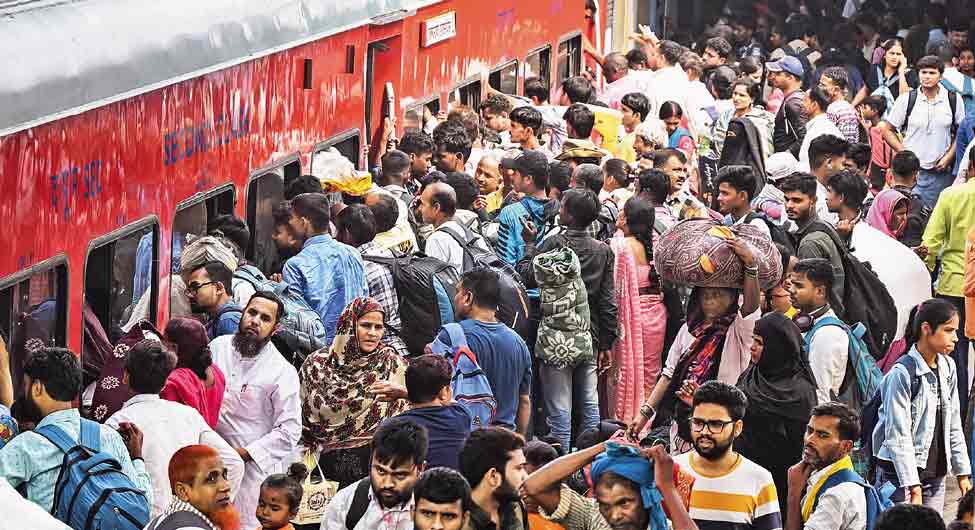
One can be both happy and sad that migration has become an issue in this Bihar Assembly elections. When the caste and sect card did not work, an attempt was made to play the employment and migration card. Some election promises were also made and despite praising good governance, both the NDA and the Grand Alliance considered it an issue. Instead of demanding an account from the government or holding it responsible for this ‘disease’, punishing it or demanding reforms, the opposition made the mistake of considering it as a vote-gathering issue, so no matter what the ruling Jamaat said, it launched a campaign to cast votes by sending back migrant Biharis not only by rail and buses but also by air (big companies sent their employees by giving them paid leave and air tickets). It is a different matter that many people made the mistake of appearing on social media by voting at two places. Haryana BJP people were seen confessing to sending poor Bihari laborers to Bihar by booking a train in the name of sending them home on Chhath and helping them exercise their franchise. Thousands of people were also brought in buses.
Chhath is also an occasion for Biharis to return home and this time there were elections, so they came and stayed with more enthusiasm. When Nitish Raj started, it was first claimed that due to good governance, the migration of workers has stopped and the phase of their return home has started. Now such a claim is not made but the fact of increase in migration is also not accepted. By the way, there is a Migrant Labor Act in the state and there is a condition of registration for laborers going out of the state. Despite this, not only Bihar, even the Central Government does not have any data as to how many workers are going out of the state. The officials and the government have forgotten about law enforcement. It is impossible for any academic institution or a single scholar to collect this number. The gist of the discussion this time was that the media people became somewhat alert and the data came out that about 75 lakh Biharis came out in a fortnight after voting. Obviously, this figure has been revealed on the basis of booking of general trains, special trains, buses etc. On this basis, the claim that the migration figure from Bihar will be between 2.5 to 3 crores seems correct.
And there is no harm in telling that most of the migration is happening under the ‘push’ factor. There is a ‘pull’ factor but there is a worrying ‘push’ factor. In this category, that laborer is counted who, due to lack of earning and unable to support his family and run his life, goes out and earns. This not only reveals his helplessness but also reveals the plight of his ‘country’ or state, which is not even in a position to make him work and ‘exploit’ him. Migration is the last stage of backwardness. This situation arises after depletion of natural resources, non-development of industrial infrastructure, running out of capital and lack of capacity to get work done in the service sector. The measures to stop it are equally long and painful. A migrant laborer is not even considered a proletariat, because he is devoid of class consciousness. He is worried about somehow saving his own life and that of his family. He is afraid of seeing a red flag.
Scholar Alakh Narayan Sharma and his organization Institute of Human Development, who have been keeping a close eye on migration in Bihar for more than three decades, believe that in Bihar, the proportion of families with a member migrating was 36 percent in 2009-10, while in 2017 it increased to 65 percent. The character of migration has also changed during this period. Earlier migration used to happen for short periods. Now migration is happening for a period of eight months or more. The proportion of short-term migration has come down to only 20 percent in 2017 instead of 72 percent in 1998-99. The conclusion of this study is that most of the laborers send an average of Rs 48 thousand home every year, which has now become a major support for their families as well as the economy of Bihar. If an industrial house had come with capital worth thousands of crores of rupees, the entire state government would have surrendered before it (this government itself has given thousands of acres of land to the Adani Group for one rupee each) but a novel can be written on the problems the workers face in sending money, returning home and investing (if anything is left, they often buy land worth two acres). The study also shows that the proportion of women among those who migrate is only five percent. Due to the migration of the men of the house, the responsibility of taking care of the elders, children, farming and animals falls on them.
This author had studied Bihari laborers who had gone to Punjab more than thirty years ago as part of his more serious journalistic work. There were no books not only in Hindi but also in English at that time. When Anupam Mishra ji referred it to an NGO working on migration, I got a proposal to update this book. Twenty years later, I visited the same places, saw the situation again and revised the book. The first book was published by Radhakrishna Prakashan with the name ‘The Plight of Migrant Labourers’. My senior Ashok Seksaria ji said that this title is somewhat incomprehensible, due to which the book did not become much popular. After his absence, when the book was redesigned, I changed the title to ‘The Plight of Bihari Laborers’. When the first work was done in 1994-95, there was Lalu government in Bihar and in 2019-20, Nitish government. Along with mentioning the book, it would also be useful to mention a personal experience. Lalu ji and Prabhash Joshi ji were also there in a TV discussion. Lalu ji refuted whatever I said. Since a long discussion was not possible there, Prabhash ji proposed a debate in Patna.
We all reached Patna for a one day seminar. Except Nitish ji, all the big Bihari leaders gathered – Lalu ji, Sushil Modi, Jagdanand ji etc. Yogendra Yadav and I wrote the pamphlet, which was published in full page by Prabhat Khabar. When Lalu ji finally spoke, he rejected all the things that had happened throughout the day and said that the movement of Anand etc. going to Sri Lanka and Biharis going to Fiji, Mauritius for religious propagation is going on and this will lead to the development of Bihar. Then he also announced that ‘Patliputra is on march.’ It became headlines in all the newspapers. When the second edition of the book came out, it was released by Nitish ji in Patna itself. Saibal Gupta, Manoj Jha, Sanjay Paswan were also there. I said that migration had slowed down a bit in the beginning of Nitish rule but now it has started increasing again. Nitish ji was displeased by this and he said a lot by taking the name of Bhai Shrikant who was sitting in the audience instead of me. In the end he also announced that now Bihari will sit on the throne of Delhi and why are you people crying? Needless to say, this line became the lead of the newspapers.
The purpose of telling this incident is that there has been no change in the attitude of those ruling Bihar for the last 35 years on the question of migration. The difference with the Congress rule, which everyone curses, was that the State Migrant Labor Law was made, a commission was constituted, even if it was just for rituals. Even during Lalu Raj, one lakh laborers were registered under the Migrant Labor Act. But today all this has been forgotten. The readiness which is there today to win the elections by wooing the Bihari laborers who have gone out, will increase manifold if the correct estimate of the number of laborers and the amount sent by them is made. Then perhaps some help center should also be run for the laborers who have gone abroad, which would help the injured/sick or Bihari laborers who are trapped in the clutches of the employer, would be helpful in their movement and if instructions are given to the police station/block to help the family in the village, it would make a lot of difference.
When the question of migration came up in the elections, I am happy that it has become an issue even after thirty years of my research. But the sad thing is that there is no data regarding their exact number, income, earnings, family status. There is a law, but it is not implemented. Delhi is the second largest city of Bihar/Biharis (today so many Biharis do not live in any other city except Patna) so by fielding Manoj Tiwari in the elections here, BJP’s ritual is completed and by providing rail and bus in Bihar elections. It becomes a master stroke to forget all the pain and suffering of Bihari women for Rs 10,000, but RJD and Grand Alliance are not even aware of this.
(Senior journalist, famous book The suffering of Bihari labourers, views are personal)