
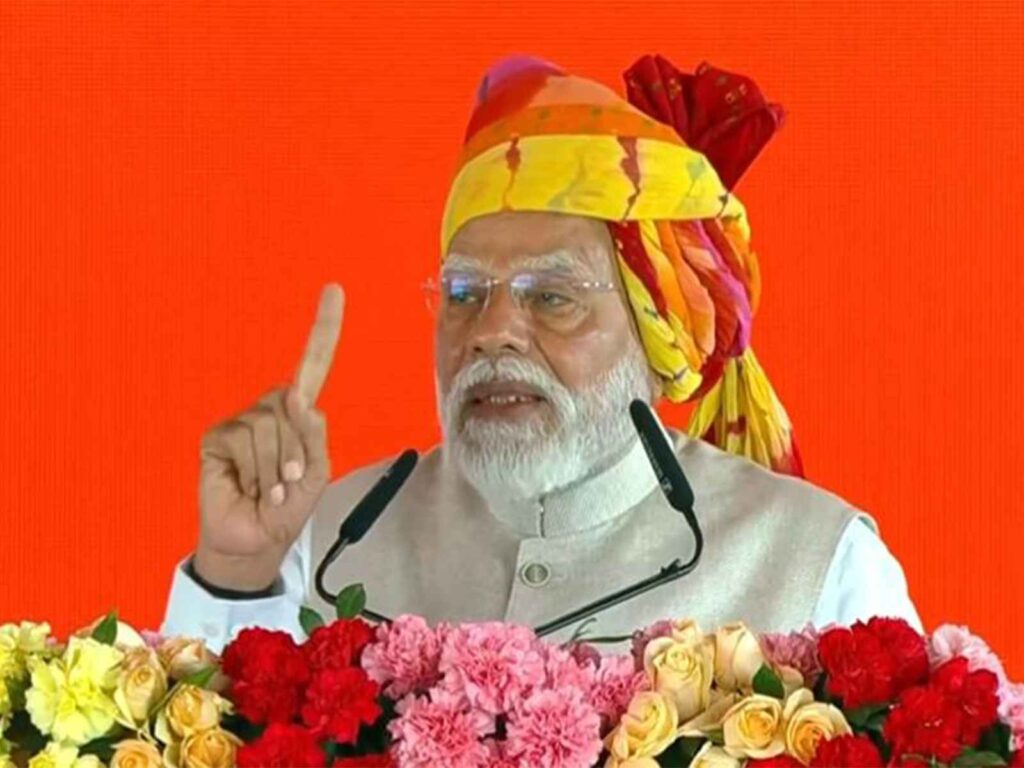
Prime Minister Narendra Modi on Saturday launched a scathing attack on the opposition Congress and cited historical events related to the partition of India, alleging that some political forces have a history of weakening the country.
Addressing a public meeting in Ajmer, the Prime Minister hit out at the opposition over defense preparedness and alleged that the armed forces had faced shortages during the Congress-led governments.
He said, “It was the same Congress that made our soldiers wait even for weapons and uniforms. The families of the soldiers were deprived of ‘One Rank One Pension’. During their tenure, massive scams took place in defense deals with foreign countries.”
The Prime Minister said that the All India Muslim League “hated India” and was responsible for the partition of the country. Making the comparison, he alleged that Congress is also following the same path.
He also accused the Congress of trying to defame the country and weaken national institutions.
He said, “Maoists hate India’s prosperity, Constitution and democracy. Similarly, Congress looks for an opportunity to defame the country and does everything possible for it. The country will never forgive such misdeeds.”
Highlighting the initiatives launched since 2014, PM Modi said that before his government came to power, basic amenities like toilets were neglected.
He said, “We saw the era before 2014 when our sisters and daughters had to endure humiliation due to lack of toilets. Girls used to drop out of school due to lack of separate toilet facilities. These were minor issues for those in power.”
Talking about development in Rajasthan, Modi said the BJP’s “twin-engine government” is working to strike a balance between legacy and progress.
He further said, “Good roads, rail and air connectivity not only make travel easier, but change the future of an entire region. When roads reach villages, farmers can sell their crops at fair prices and traders can expand their markets.”