
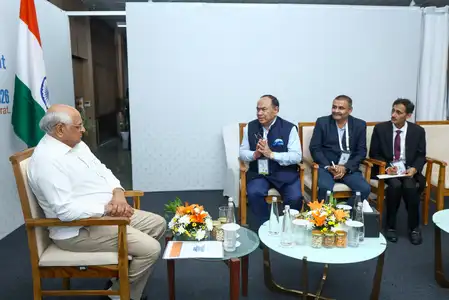
Surat, May 1 (IANS). During a series of policy and industry-related discussions at the ‘Vibrant Gujarat Regional Conference’ (VGRC) held in Surat on Friday, special emphasis was laid on strengthening self-reliance in the fertilizer sector as well as increasing investment in tourism infrastructure in the tribal areas of the state.
At Auro University, a national-level panel discussion on “Strategies for achieving self-reliance through import substitution in the fertilizer sector” was held, jointly organized by the Department of Energy and Petrochemicals of the State Government and VGRC.
The session was attended by over 100 participants, including experts from the fertilizer industry, agriculture sector, academia and policy institutions.
Participants discussed India’s continued dependence on imports for key fertilizer inputs, particularly potash and phosphatic raw materials, and assessed the need to increase domestic production capacity.
Technology-based solutions and policy interventions to improve long-term sustainability in agriculture also remained the focus of the discussions.
Experts emphasized that while on one hand India is one of the largest consumers of fertilizers in the world, on the other hand it is still dependent on external sources for many important components.
The discussion underlined the importance of increasing domestic production of urea, diammonium phosphate (DAP) and complex fertilizers; Besides, it was also said to promote alternatives like nano urea, bio-fertilizer and organic inputs to reduce import dependence and production cost.
He also mentioned that changing global geopolitical circumstances, supply chain disruptions and fluctuating input prices have made self-reliance in the fertilizer sector even more important for India’s agricultural economy.
The discussion concluded that coordinated efforts are needed between government bodies, industry stakeholders and research institutions to ensure stable and affordable supply of fertilizers to farmers.
In a separate session of the same conference, the state government outlined its focus on developing tourism infrastructure in tribal and rural areas; Along with this, he also talked about promoting initiatives related to eco-tourism and cultural heritage.
Addressing a seminar organized on tourism development, State Tourism Minister Dr. Jairam Gambit mentioned the growing tourism potential in the tribal areas of South Gujarat, and highlighted Saputara as a major tourist destination.
He said that the number of tourists coming to Saputara has increased from 1.13 lakh in the financial year 2023-24 to 1.19 lakh in the financial year 2025-26.
–IANS
SCH