
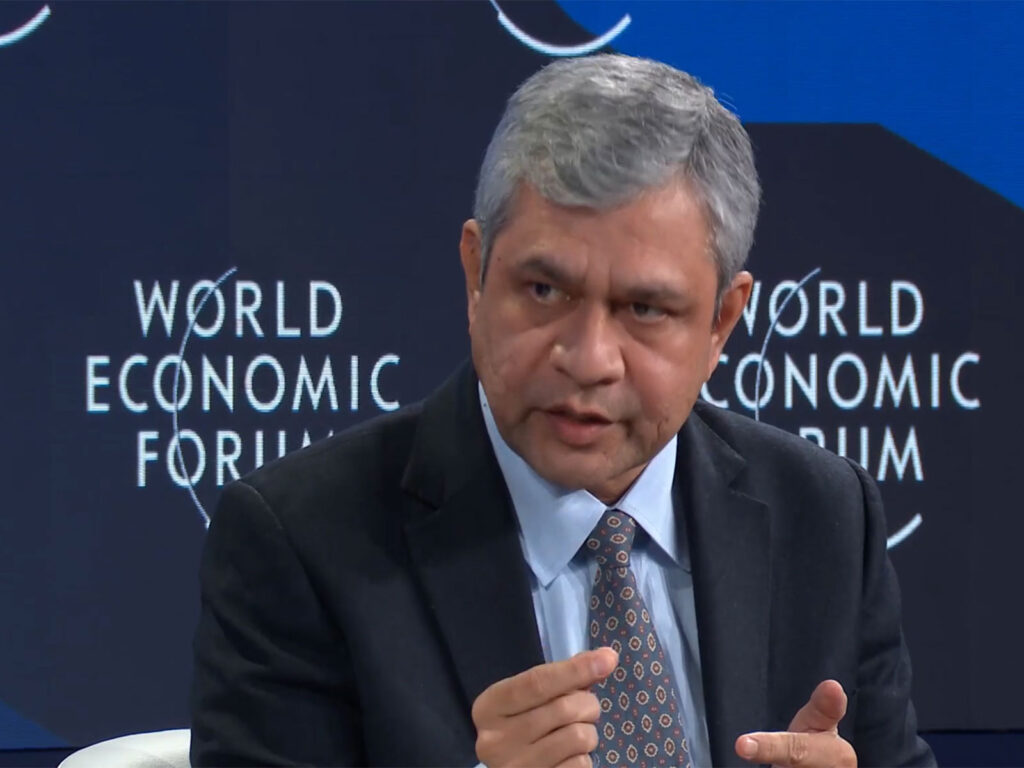
Union Electronics and Information Technology Minister Ashwini Vaishnaw on Wednesday said India will continue to grow at 6 to 8% in real and 10 to 13% in nominal terms over the next five years.
Speaking at the ‘Bet on India Bank on the Future’ session organized by the Confederation of Indian Industry (CII) in collaboration with EY along with the World Economic Forum (WEF) 2026 in Davos, Vaishnav talked about the government’s efforts for ease of doing business.
“India will continue to grow at 6 to 8% in real and 10 to 13% in nominal terms, supported by moderate inflation and strong growth,” he said.
The Minister highlighted the importance of simplification of permissions and pointed out that the average time for permission to set up a telecom tower has reduced from 270 days to 7 days, with 89% of permissions received in zero time.
He also stressed that there is a need to bridge the gap between intention and methodology.
Vaishnav also discussed the importance of communicating about challenges among industry members, mentioning the standardization of data localization norms in the US and Europe.
Rajeev Memani, president of CII and regional managing partner of EY’s Africa-India region, called for increasing India’s per capita income at least five times by 2047.
He highlighted India’s strategy to diversify trade ties and said agreements with regions such as the Middle East, Asia Pacific and the United Kingdom are becoming increasingly important. He also pointed to important reforms undertaken domestically such as labor reforms and implementation of GST, which reduced tax rates on consumer food products.
CII Director General Chandrajit Banerjee said, “This discussion is particularly timely. As the global economy grapples with uncertainty, fragmentation and rapid technological change, India emerges as a market of immense stability and long-term opportunities.”
Earlier in Davos, Ashwini Vaishnav rejected International Monetary Fund (IMF) Managing Director Kristalina Georgieva’s suggestion that India comes second to other major economies, and said India is clearly in the first group globally.
“I don’t know what the IMF’s criteria have been, but Stanford has ranked India third in terms of AI penetration, AI readiness and AI talent,” he said during a panel discussion at the World Economic Forum (WEF).
Addressing the IMF chief directly regarding the classification, he said, “I don’t think your classification in the second book is correct. It is actually correct in the first book.”
The Union Minister detailed India’s comprehensive strategy at all five levels of AI architecture (application, model, chip, infrastructure and energy level). He said that India is making significant progress in all these areas to ensure self-reliance in the global technological scenario.
Vaishnav emphasized that India is paving its own path rather than strictly following the patterns set by the US or China.