
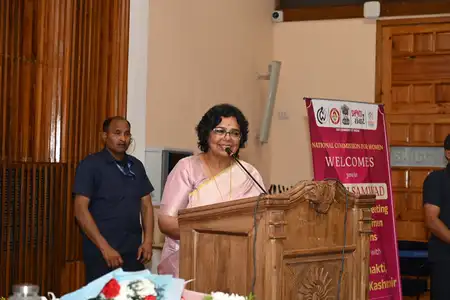
Srinagar, May 17 (IANS). The National Commission for Women (NCW) organized a two-day ‘Shakti Samvad’ program in Srinagar during the weekend, which was attended by chairpersons, members and member secretaries of state women commissions.
The objective of the ‘Shakti Samvad’ program was to strengthen coordination among the respective commissions for women empowerment.
Representatives from 20 states participated in the event, whose main focus was on strengthening institutional coordination, enhancing capacity building and promoting dialogue for the welfare and empowerment of women.
Addressing the inaugural session, NCW chief Vijaya Rahatkar said, “Today there is a need to not only make plans and policies, but also to create an accountable ecosystem. An ecosystem where the NCW becomes a center of trust, justice and support and not just a platform for grievance redressal.”
She further said, “Where every woman feels that she will be heard and gets justice with dignity. ‘Shakti Samvad’ is not just a programme, but it is a living symbol of the collective resolve of India’s women power. It is the platform where ideas meet, experiences connect and resolutions turn into power.”
He emphasized that while women today are making remarkable contributions in governance, judiciary, science, media and various spheres of public life, it remains the collective responsibility of all of us to ensure their safety, dignity and equal opportunities.
She also emphasized that Women’s Commissions are not just grievance redressal institutions, but they are institutions of trust, support and justice for women.
Minister of State Jitendra Singh, who attended the event as the chief guest. He said, “Women of Jammu and Kashmir are emerging as a strong force of progress and leadership. Our daughters are excelling in the fields of education, civil services and innovation, and they will play a vital role in shaping the future of ‘Developed India by 2047’.”
She underlined the importance of coordinated institutional efforts and policy support in pursuing women-led development in India. He also emphasized that science and technology are powerful vehicles for social change, and can play a decisive role in improving the lives of women by increasing their access to education, healthcare, entrepreneurship and digital opportunities.
Experts and participants also deliberated and shared their views on topics such as changing legal frameworks, dignity at the workplace and institutional responses in the context of emerging challenges affecting women across the country.
–IANS
SCH