
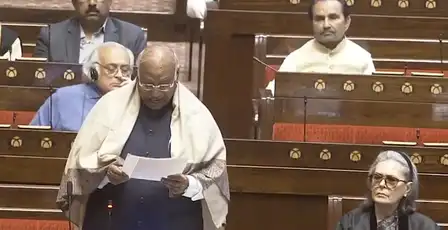
New Delhi, February 12 (IANS). Leader of Opposition in Rajya Sabha and Congress President Mallikarjun Kharge raised the issue of caste discrimination. Speaking in the House, he said that we often talk about the upliftment of Dalits, deprived and weaker sections. Now is the time to take concrete initiatives to implement these things on the ground. Social justice is not just a slogan but the soul of the Constitution and it is the collective responsibility of all of us to protect it.
Speaking in the Rajya Sabha, he said that in the twenty-first century, when we talk about social development, reform and unity, an incident from Odisha shows us a mirror. There is a boycott going on for three months in an Anganwadi center just because the food is being prepared by a Dalit woman helper and cook. Some people of a particular community are refusing to give that food to their children. This is not just an insult to a woman, but also a test of our constitutional values and social consciousness.
He said that this is a very serious topic on which he wants to draw the attention of the House. Anganwadi centers are the foundation of children’s physical and mental development. If a wall of caste prejudice and discrimination is erected there, it will have a direct impact on the minds of children and their future. When this kind of discrimination happens in front of small children, then unknowingly the seeds of division and hatred are sown within them. This situation weakens the spirit of the right to education under Article 21(a) of the Constitution. Also, under Article 47 it is the responsibility of the State to raise the nutritional level and improve public health. If nutrition programs themselves fall prey to caste based thinking, then it also raises questions on the responsibility of the state.
Mallikarjun Kharge said that this incident should not be ignored as just a social dispute. This should also be seen in the context of widespread caste-based discrimination in workplaces. Many such incidents have come to light in recent years. An inhuman incident that happened with a tribal laborer in Madhya Pradesh came to light, which shocked us. A Dalit government employee in Gujarat committed suicide after being fed up with alleged harassment. Allegations of institutional discrimination emerged after the death of a senior police officer in Chandigarh. All these incidents indicate that caste prejudice is not limited to just one section of the society, but also exists somewhere in the institutional structures.
He said that such behavior is a clear violation of Articles 14, 15 and 17 of the Constitution, which guarantee equality, prohibition of discrimination and abolition of untouchability. Along with this, there are also strict laws like Scheduled Castes and Scheduled Tribes (Prevention of Atrocities) Act. Their objective is to prevent such crimes and punish the culprits.
He said that he urges the government to take such matters very seriously. Wherever such caste discrimination comes to light, there should be a prompt and fair investigation, strict action should be taken against the culprits and safety and justice should be ensured to the victims. Also, social harmony should be promoted by running awareness campaigns in sensitive institutions like Anganwadi, so that values of equality and respect are developed in the minds of children.
–IANS
gcb/sk