In the shadow of controversies, Mahayuti changed the complexion of power in Mumbai Municipal Corporation after a long time, but the results do not testify to any major lack in support of Shiv Sena.
Municipal corporation elections rarely attract people’s attention like assembly or Lok Sabha elections. Nevertheless, the recently held municipal corporation elections in Maharashtra aroused much interest. Most importantly, the stakes were high in the elections of Brihanmumbai Municipal Corporation (BMC), where elections were announced after four years after the order of the Supreme Court. It is noteworthy that BMC is the richest municipality in the country, whose annual budget is Rs 74,000 crore. This amount is more than the sum of the budgets of small states like Goa, Sikkim, Himachal Pradesh. Well, apart from the ward results and the mayor’s arithmetic, these elections also present a picture of changing political loyalties, coalition equations as well as the growing contradiction between election results and public trust.
Because of these confused messages, the mayor’s election is still awaited ten days after the results came on January 16. In fact, despite all the allegations and counter-allegations on the day of voting, the results finally decided that the Mahayuti i.e. the alliance of BJP and Shinde Shiv Sena benefited, but the BJP’s seats in Mumbai did not increase so much (82 in 2017 to 89 in 2026) that it could fulfill its long political dream of making its mayor on its own. Shinde Shiv Sena got 29 seats and Uddhav Shiv Sena got 65 seats. This number is more than the 92 seats won by undivided Shiv Sena last time. It is also worth noting here that last time 54 councilors had broken away and gone with Shinde, yet the current results are not too disappointing for the Uddhav faction.
Raj and Uddhav Thackeray
Perhaps this mathematics became of special importance for Deputy Chief Minister Eknath Shinde and he is indicating that even in 2017, BJP’s seats had increased due to the alliance with Shiv Sena (before that in the 2012 elections, BJP had got only 36 seats) and this time also, if their support had not been there, BJP would not have emerged as the largest party. However, Shinde kept his new councilors together in a hotel for several days, so that there was no rift. He also did not fail to say that he was more afraid of breakdown from within.
On the other hand, Shiv Sena faction leader Uddhav Thackeray had a faint hope that “God willing, the mayor will be from Shiv Sena.” He was referring to the lottery system in which it is decided which category (general, women, scheduled caste or scheduled tribe) will be the mayor this time. If the slip comes out for the Scheduled Tribe category, then only the Uddhav faction has two councilors from that category. Another reason for the hope of the Uddhav group and the aspiration of the Shinde group is that this is also the centenary year of the founder, late Bal Thackeray. But the slip turned out to be of women’s category. In recent years, citing an amendment, the Scheduled Tribe category slip was not cast at all.
Mahayuti got 120 seats out of the total 227 BMC seats, while the alliance led by the Thackeray brothers came second with 73 seats. Congress could take 24 seats. This election is going to witness the end of decades of political era in Mumbai. This signals a major change in the city’s power structure. The city is going to have a mayor again after a gap of four years. The last mayor of Mumbai was Kishori Pednekar of the undivided Shiv Sena. She was the chair from November 22, 2019 to March 8, 2022.
Despite this, the issue is still stuck and it is possible that the mayor’s election may take some more time. The problem is not only in Mumbai but also in other municipal corporations. At other places too, a settlement is yet to be reached on the name of the mayor. Well, the results also show that Mahayuti has established its dominance in urban Maharashtra. The BJP-led Mahayuti alliance won the results of 29 municipal corporations in the state. In major urban centers like Pune and Pimpri-Chinchwad, the BJP has decisively overtaken Ajit Pawar’s NCP and the Sharad Pawar-led NCP (SP) alliance, indicating a decline in the traditional influence of the regional giants. Both the NCP factions, which came together on one platform in these elections, could not shine in Pune. BJP secured a huge lead in 110 out of 165 seats in Pune Municipal Corporation and 81 out of 128 seats in Pimpri-Chinchwad.
Similar results were seen throughout Western Maharashtra. BJP is ahead in municipal bodies like Kolhapur, Satara, Solapur and Sangli. Overall, the BJP won more than 1,170 wards across the state. Its ally Eknath Shinde’s Shiv Sena won more than 300 wards. These figures indicate not only the electoral success but also the dominance of the Mahayuti over the urban bodies.
Another thing to be noted in this change is that the relative performance of Congress has improved. She has managed to snatch two municipal corporations, including Latur, from the BJP and has also managed to save her support in Dharavi, which has the biggest stakes in Mumbai. These results are definitely going to create trouble for both the factions of NCP. In Mumbai they were reduced to 5 seats (3 for Ajit group and 2 for Sharad Pawar camp).
Along with the election results, many questions have been raised on the entire electoral process. Opposition parties have accused the BJP of large-scale ‘vote theft’ and distributing money and household items before voting. Congress spokesperson Dr. Shama Mohammed alleged that BJP distributed goods before voting. He questioned the inaction of the Election Commission and asked, “If this is not vote theft, then what is it?”
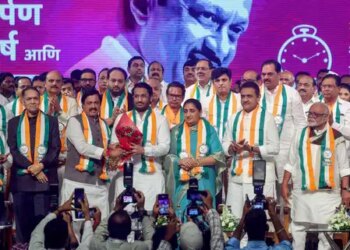
After a long time: Devendra Fadnavis (center) with the winning candidates in BMC.
Administrative disputes have further complicated the matter. The State Election Commission had to intervene following complaints of the marker ink being light, while in areas like Juhu and Bandra of Mumbai, there were reports of names missing from the voter list, technical glitches in the voter apps and disturbances at the booths.
Some voters alleged that their votes went towards the other party. These are claims which have not been proven but have increased people’s distrust.
Overall, Maharashtra’s municipal elections are not just about victories and defeats. Rather, they show that BJP’s grip on urban politics is increasing. This result reflects the new political challenges facing the fragmented opposition and regional parties. If the opposition had fought with more unity then perhaps a difference could have been seen.