
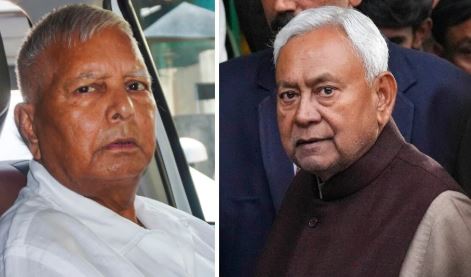
Bihar Chief Minister Nitish Kumar launched a scathing attack on Rashtriya Janata Dal (RJD) chief Lalu Prasad and said that he “did nothing for women” while in power and when it came time to step down after the charge sheet was filed in the fodder scam, he made his wife Rabri Devi the Chief Minister.
Janata Dal (United) president Kumar targeted the RJD president while addressing the first election meeting of the National Democratic Alliance (NDA) in Meenapur assembly constituency of Muzaffarpur district.
He said he was “disappointed” with the experience of two alliances with the RJD and has now resolved to remain with the NDA permanently.
Highlighting his government’s initiatives for women empowerment, Kumar said his government has formed Self Help Groups (SHGs) on a large scale and an amount of Rs 10,000 each has been transferred to the accounts of more than one crore beneficiaries under the recently launched ‘Mukhyamantri Mahila Rozgar Yojana’.
Without naming Lalu Prasad, he said, “Those who were in power earlier, did they do anything for women?” He didn’t care about it. When it became mandatory to resign after being the Chief Minister for seven years, his wife was made the Chief Minister.
Lalu Prasad was the Chief Minister of Bihar from 1990 to 1997. After his resignation, his wife Rabri Devi was made the Chief Minister. This move was quite controversial at that time.
Kumar reminded that he along with BJP had ousted RJD from power in 2005. He said that both the alliances with RJD in 2015 and 2022 lasted for less than two years.
He said, “Due to circumstances I had to go with them, but soon realized that they were of no use. Now I am back in NDA forever.
Kumar also mentioned the efforts made by his government to improve infrastructure, education and health in the state and appreciated the cooperation of the Prime Minister Narendra Modi-led government at the Centre.
He said, “Earlier there was an atmosphere of terror in Bihar. Criminals got protection from power. But now everyone can see how much the situation has changed. Even Hindu-Muslim conflicts have reduced because we have shown sensitivity to the needs of both communities like security of religious places.