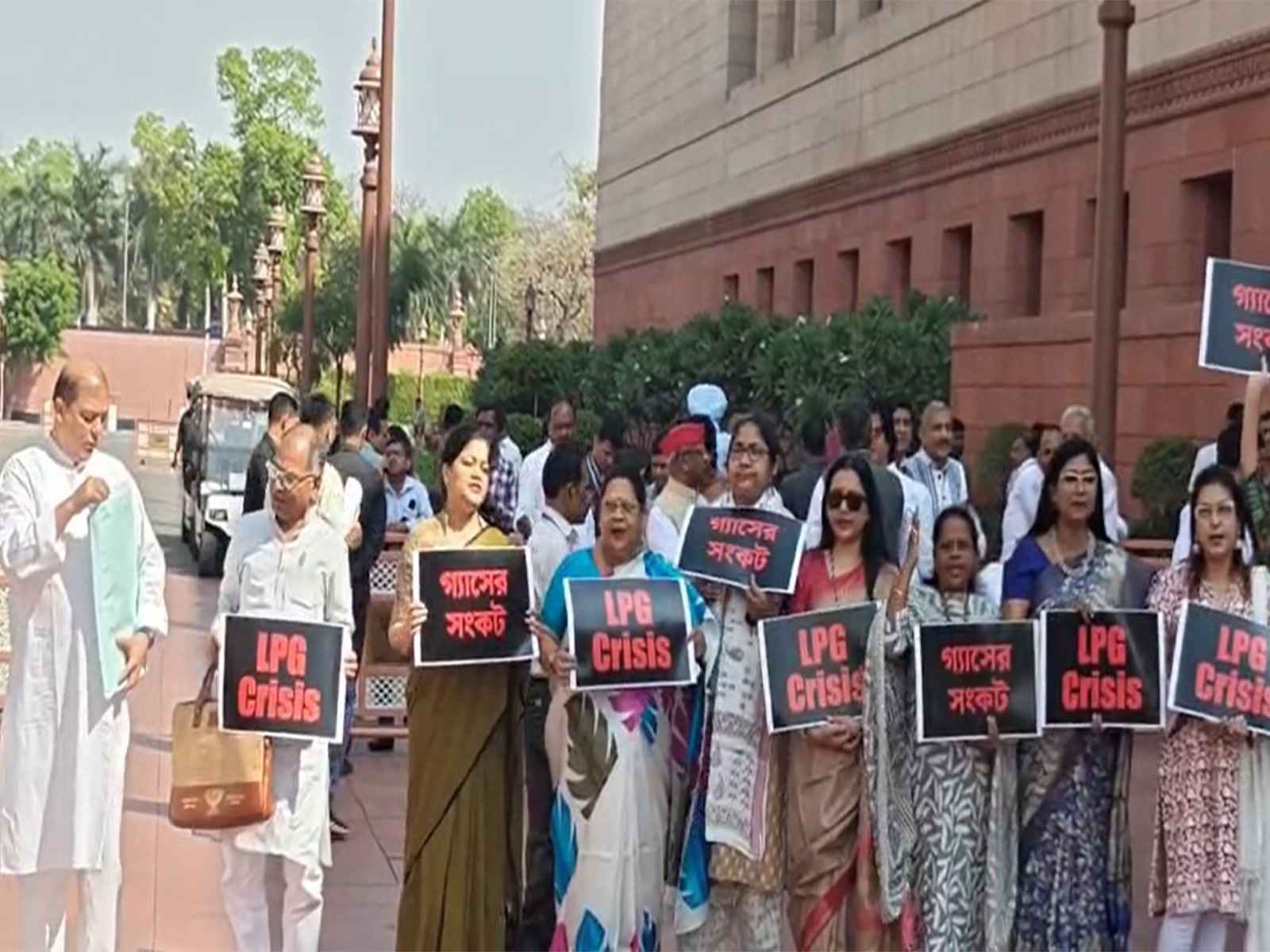
Trinamool Congress (TMC), along with other opposition MPs, on Thursday demonstrated at Makar Dwar in the Parliament complex to protest against the shortage of LPG cylinders across the country.
The protesters reportedly raised slogans of “LPG, LPG” to highlight the crisis. Additionally, some opposition MPs raised slogans “Hindustan standing in Qatar, Modi roaming China Japan”, expressing concern about Indian citizens stranded in Middle Eastern countries.
Congress MP JB Mather said, “Just by saying there is no shortage, how will there be no shortage? Union Minister Shri Puri is trying to show that there is nothing wrong here. We have to accept that there is a crisis. Then we have to find ways to deal with this crisis. Rahul Gandhi tried to do the same in Parliament yesterday, but he was stopped from speaking. Let us accept this and find solutions, but this government is turning away from reality.”
Meanwhile, Congress MP Jairam Ramesh claimed that the Modi government is “clearly intimidated” by the discussion in both Houses of Parliament on the situation in West Asia and its impact on India.
“The opposition is demanding a full discussion in both Houses of Parliament on the situation in West Asia and its implications for India. But the Modi government is flatly refusing to allow such a debate. It is clearly scared. Its foreign policy has already been badly exposed,” the Congress MP said on social media.
The opposition is pressurizing to discuss West Asia in Parliament. Congress leaders, led by Leader of Opposition in Lok Sabha Rahul Gandhi, also protested in the Parliament complex over the LPG issue.
Apart from this, many MPs today criticized the stance of Prime Minister Narendra Modi and Union Petroleum and Natural Gas Minister Hardeep Singh Puri on fuel security. Speaking to reporters, the leaders alleged that ordinary citizens were struggling for essential energy supplies due to the government’s foreign policy.
Samajwadi Party MP Dimple Yadav said, “We are asking the government about the arrangement for LPG. We can see that people are standing in long queues to buy LPG.”
Congress MP KC Venugopal said, “They are not living in reality. They are living in an imaginary world… Even in our constituencies, people are suffering badly. In the capital we can see how people are troubled. This reality is not affecting them because they are living in a different world, not with the common people. The common people are troubled only because of the attitude and foreign policy of this government. They do not want Rahul Gandhi to speak on these issues.”
On the other hand, RJD MP Manoj Kumar Jha, while speaking to ANI, said, “Denial is not a good approach, they should take everyone along and accept that the problem exists.”
However, the Center said in Parliament that domestic LPG production has increased by about 25 per cent and the entire domestic LPG production is being directed towards domestic consumers.
The government said that essential sectors like hospitals and educational institutions are being given priority for non-domestic LPG.
Meanwhile, Union Petroleum and Natural Gas Minister Hardeep Singh Puri on Thursday assured Parliament that India’s energy supply remains secure despite global disruptions caused by the ongoing conflict in West Asia and the resulting closure of the Strait of Hormuz.
In his statement in the Lok Sabha, Puri said the government has taken several measures to safeguard the energy security of the country and ensure uninterrupted availability of petroleum products, cooking gas and natural gas.
In a post on X he reiterated, “Despite the current geopolitical situation involving major energy producers, our energy imports are secure and continue to flow from various sources using the Hormuz-free routes. We are well positioned and able to meet the energy needs of our citizens.”
“There is no shortage of petrol, diesel, kerosene, aviation turbine fuel or fuel oil. There is adequate stock in retail outlets across the country and supply chains are functioning normally,” the minister said.
His statement in the Lok Sabha came at a time when concerns have increased globally over disruption of shipping transit through the Strait of Hormuz following the ongoing conflict between Iran, Israel and the United States. Generally, about 20 percent of the world’s crude oil, natural gas and LPG flows through this strait.
Puri said India has successfully diversified its crude oil sourcing to reduce dependence on the Strait of Hormuz. Before the crisis, about 45 percent of India’s crude oil imports passed through the strait.
He said, “India’s crude oil supply position is secure, and the secured quantity exceeds the quantity supplied through the Strait of Hormuz. Before this crisis, about 45 percent of India’s crude oil imports passed through the Strait of Hormuz.”
He further said, “Procurement of crude oil from countries other than Hormuz has increased to about 70 per cent of crude oil imports, which was 55 per cent before the conflict started. India now buys crude oil from 40 countries, whereas in 2006-07 this figure was from 27 countries.”