
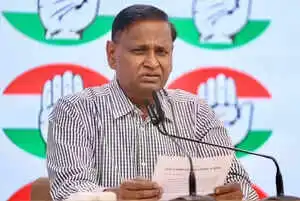
New Delhi, December 29 (IANS). After the statements of senior Congress leader Digvijay Singh, former MP Udit Raj has admitted that there is organizational weakness in the party. He has also claimed that there is a lot of factionalism in the party and that is why the district president could not be decided for 10 years.
Udit Raj was questioned about the statements of Digvijay Singh. While talking to news agency IANS, he replied that if there was no organizational weakness in the party, we would not have lost elections again and again.
He said, “There is organizational weakness and there is no doubt about it. For 10-10 years, the district president could not decide, because when it was decided, due to factionalism, the second or third group would stop it.” He further said, “Introspection is a healthy democracy. I don’t know where people consider introspection to be a protest, a break in the party.”
However, Udit Raj said in his statement that it is the tradition of Congress to discuss. The tradition of Congress is such that we introspect. Right now we are removing our shortcomings.
Earlier, Digvijay Singh had spoken about organizational weakness. Recently, in the Congress Working Committee meeting, he also raised his views regarding the strength of the organization.
On bulldozer action in Karnataka, the Congress leader said, “Bulldozers are used everywhere to remove encroachment on government land. It is a different thing to run bulldozers and demolish them on the basis of caste and religion. But in Karnataka, bulldozers are used to vacate government property.”
On Congress leader Praveen Chakraborty’s statement regarding the debt situation of Tamil Nadu, Udit Raj said, “Mostly the investment, manufacturing and service sectors are growing in Tamil Nadu. Accordingly, if there is debt, on the other hand there is also income and jobs. GDP and manufacturing are very high.”
–IANS
DCH/