
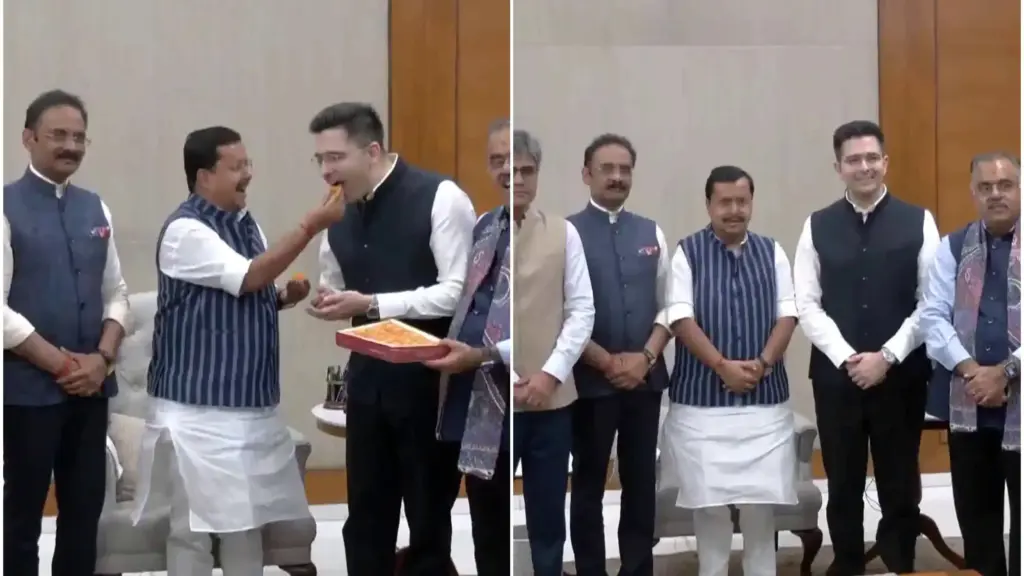
There is a serious crisis facing the Aam Aadmi Party (AAP)—the party that emerged from the anti-corruption movement some 14 years ago and claimed to revolutionize the policies and intentions of Indian politics. The party suffered a major blow on Friday (April 24, 2026) when seven of its Rajya Sabha members announced their decision to leave the party and join the BJP. This defection of almost two-thirds of AAP’s Rajya Sabha members has raised questions on the internal unity of the party.
Raghav Chadha said: All MPs have signed
Raghav Chadha said that according to the Constitution, two-thirds of the total MPs of a party are allowed to join another party. After resigning from AAP, Raghav Chadha, Ashok Mittal and Sandeep Pathak joined BJP. Raghav Chadha further told that Swati Maliwal, Harbhajan Singh, Rajinder Gupta and Vikram Sahni are also joining BJP. He told that in this matter Rajya Sabha Chairman C.P. A letter has already been handed over to Radhakrishnan, which is signed by all the MPs involved.
BJP’s ‘Operation Lotus’: AAP
Aam Aadmi Party has termed this development as BJP’s “Operation Lotus”. The party alleges that a conspiracy was hatched to break the AAP leaders by using the threat of central agencies like ED and CBI. AAP’s Rajya Sabha MP Sanjay Singh said that through “Operation Lotus” BJP’s aim is to destabilize the Bhagwant Mann-led government in Punjab. He stressed that this was a betrayal of Punjab and its people—a betrayal that the people of Punjab would never forget.
**Nitin Naveen’s message for the remaining 4 MPs**
BJP National President Nitin Naveen welcomed all the members at the party headquarters by feeding them sweets. Posting on ‘X’ (earlier on Twitter), he wrote a special message especially for Harbhajan Singh, Swati Maliwal, Vikram Sawhney and Rajinder Gupta. He wrote, “Welcomed Raghav Chadha, Sandeep Pathak and Ashok Mittal to the BJP family at the party headquarters.” “Also, all the best to Harbhajan Singh, Swati Maliwal, Vikram Sawhney and Rajinder Gupta as they serve under the leadership of Prime Minister Narendra Modi.”
**Party will file complaint against three MPs
Aam Aadmi Party (AAP) termed this move as a violation of rules. AAP’s Rajya Sabha Whip, N.D. According to Gupta, he was talking to Rajya Sabha Chairman, C.P. regarding Raghav Chadha, Sandeep Pathak and Ashok Mittal. Will hand over a letter to Radhakrishnan. Since these three leaders have officially announced to join BJP, AAP’s Rajya Sabha whip will file a complaint specifically against these three MPs. Harbhajan Singh, Swati Maliwal, Vikram Sahni and Rajinder Gupta have not yet publicly said that they are joining BJP.
**Demand for action against Raghav Chadha, Ashok Mittal and Sandeep Pathak
AAP leader Sanjay Singh said he will seek disqualification of Raghav Chadha, Ashok Mittal and Sandeep Pathak from the Upper House for joining BJP. He said, “I will submit a letter to the Honorable Chairman of Rajya Sabha, demanding cancellation of Rajya Sabha membership of Raghav Chadha, Ashok Mittal and Sandeep Pathak on the basis of joining BJP.” He further argued that his decision to join another party amounts to voluntarily giving up his parent party membership under the Tenth Schedule of the Constitution.
**AAP raised questions on the stance of the remaining four MPs**
Apart from these three MPs, the Aam Aadmi Party also raised questions regarding the stand of the remaining four Rajya Sabha MPs. Amidst the ongoing schism within the Aam Aadmi Party, Swati Maliwal posted on ‘ I am in Itanagar now to attend a parliamentary committee meeting. I will discuss the matter in detail after returning to Delhi tonight.”
**What is Anti-Defection Law?** ‘Anti-Defection Law’ was enacted in 1985 under the Tenth Schedule of the Indian Constitution. Its main objective is to stop the practice of changing parties in politics and to ensure stability in governments elected by the public. Simply put, if a Member of Parliament (MP) or Member of the Legislative Assembly (MLA) voluntarily leaves the political party on whose ticket he was elected, or votes contrary to the instructions of his party in the House, his membership of the House can be terminated. Clause 4 of the Tenth Schedule provides that if two-thirds (2/3) of the members of a political party collectively defect and merge with another party, this law does not apply to them, and their membership remains intact.