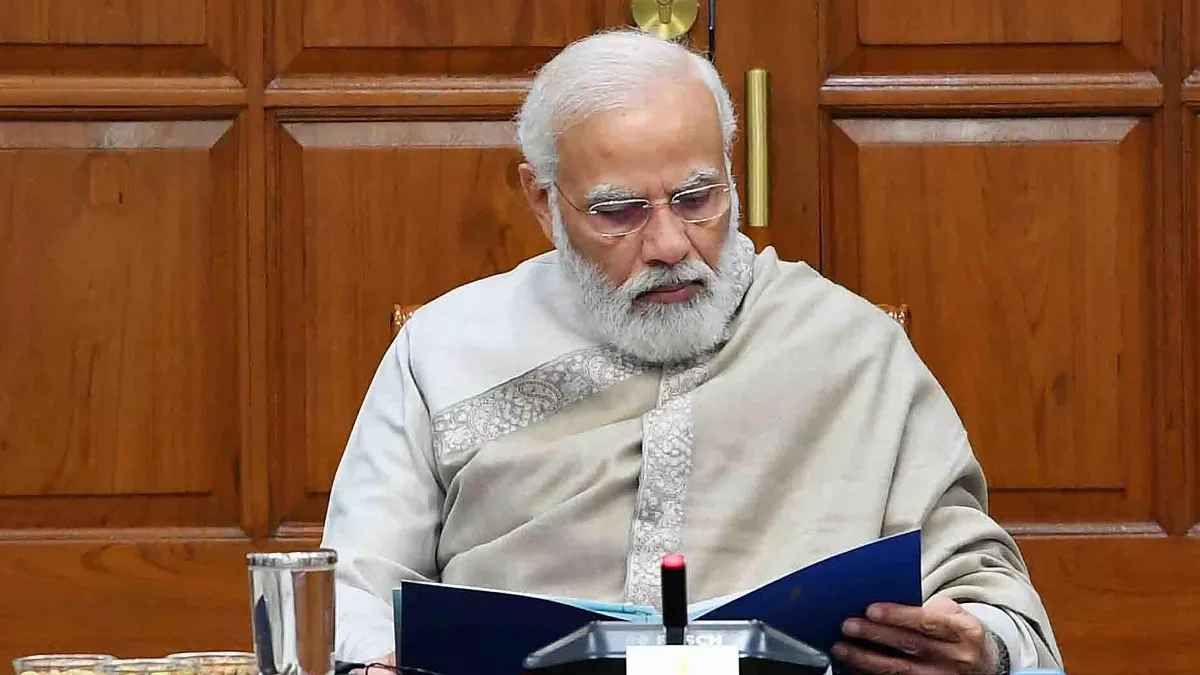
Prime Minister Narendra Modi on Wednesday emphasized the mantra of reform, performance and transformation at the 50th meeting of Pragati, which has set in motion projects worth over Rs 85 lakh crore in the last decade. Chairing the meeting, the Prime Minister emphasized the use of technology at each stage of the project life cycle.
He said that the Proactive Governance and Timely Implementation (PRAGATI) platform should be further strengthened in the coming years to ensure quick implementation, high quality and measurable outcomes for citizens.
During the meeting, the Prime Minister reviewed five important infrastructure projects from different sectors including roads, railways, power, water resources and coal. “These projects are spread across five states, with a total cost of over Rs 40,000 crore,” an official statement said.
It said that during the review of PM Shree Yojana, the Prime Minister emphasized that this initiative should become a national benchmark for holistic and future-ready school education, with outcome-oriented implementation rather than focus on infrastructure.
He also directed all the Chief Secretaries to keep a close watch on the PM Shri Yojana. The Prime Minister also stressed that efforts should be made to make PM Shree Schools a benchmark for other schools of state governments.
He also suggested that PM Shri should visit senior government officials at the ground level to evaluate the performance of schools.
Modi said progress is necessary to maintain the pace of reforms and ensure their results. On this occasion, the Prime Minister shared clear expectations for the next phase and outlined his vision of reform, performance and transformation.
The Prime Minister said, “Reform for simplicity, perform to deliver results, transform to impact.”
He said reforms should mean moving from process to solutions, simplifying processes and making systems more conducive to ‘ease of living’ and ‘ease of doing business’.
The Prime Minister said performance should mean equal focus on time, cost and quality. He further said that result-oriented governance has been strengthened through progress and now needs to be taken deeper.
Modi said change should be measured on how citizens actually feel about timely services, prompt resolution of complaints and improvement in living standards.
He also said that long pending projects in national interest have been completed using the Pragati platform. The Prime Minister further said that Pragati is an excellent example of cooperative federalism and breaks the isolated practice.
In the 50th Pragati meeting, the Prime Minister described this achievement as a symbol of the deep change that has taken place in the culture of governance in India in the last decade.
Modi emphasized that when decisions are taken timely, coordination is effective and accountability is fixed, the pace of government work naturally increases and its impact is directly visible in the lives of citizens.
The Prime Minister reminded that the progress had its origins in the technology-enabled Statewide Grievance Redressal Platform (SWAGAAT), which he had launched during his tenure as Chief Minister of Gujarat.
Building on that experience, he extended the same spirit to the national level through Pragati, bringing large projects, major programs and grievance redressal onto a unified platform for review, resolution and follow-up.
The Prime Minister noted that over the past few years, the Pragati-led ecosystem has helped accelerate projects worth over Rs 85 lakh crore and supported the grassroots implementation of key welfare programs on a large scale.
He said 377 projects in progress since 2014 have been reviewed, and out of 3,162 problems identified in these projects, 2,958 – about 94 per cent – have been resolved, significantly reducing delays, cost overruns and coordination failure.
The Prime Minister also said that with India’s rapid progress, the relevance of progress has increased even more.
He said progress is necessary to maintain the pace of reform and ensure implementation, and added that since 2014, the Government has worked to institutionalize implementation and accountability by creating a system where work is taken forward with consistent follow-up and completed within time-frame and budget.
He said that projects which were started earlier but remained incomplete or were forgotten have been revived and completed in the national interest.
The Prime Minister said that many projects initiated under the Pragati Manch which were stalled for decades were completed or taken forward decisively.
He gave the example of the Bogibeel rail-cum-road bridge in Assam, which was first conceptualized in 1997; Jammu-Udhampur-Srinagar-Baramulla rail link, work on which began in 1995; Navi Mumbai International Airport, which was conceptualized in 1997; Modernization and expansion of Bhilai Steel Plant, which was approved in 2007; and the Gadarwara and Lara Super Thermal Power Projects, which were sanctioned in 2008 and 2009 respectively.
The Prime Minister said projects do not fail simply because of lack of intention – many projects fail because of lack of coordination and isolated functioning. He said Pragati has helped solve this problem by bringing all stakeholders on one platform and working towards a common goal.
Since its inception, approximately 500 secretaries of the Central Government and Chief Secretaries of states have participated in Pragati meetings. The Prime Minister also said that the government has ensured adequate resources for national priorities and sustained investment across all sectors.
He said Develop India@2047 is both a national pledge and a time-bound target, and progress is a powerful catalyst to achieve it. The Prime Minister also encouraged states to institutionalize similar arrangements like Pragati, especially at the Chief Secretary level for the social sector.