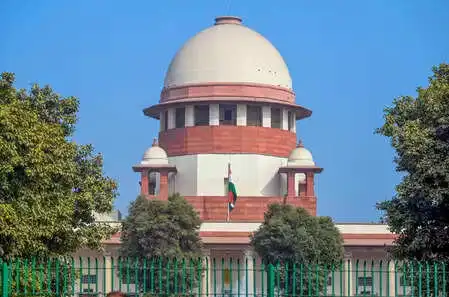
New Delhi, June 15 (IANS). The Supreme Court on Monday issued a notice to the Punjab government on a public interest litigation (PIL). The petition alleges that the Right of Children to Education (RTE) Act, 2009 is not being implemented consistently, due to which children from weaker sections and disadvantaged groups are being deprived of free education.
A bench of Chief Justice of India (CJI) Surya Kant and Justice V. Mohana passed the order while hearing a petition filed by KS Raju Legal Trust through its representative Dr. Jagmohan Singh Raju.
During the hearing, the petitioner argued that many private schools in Punjab have failed to comply with the mandate under Section 12(1)(c) of the RTE Act, under which it is mandatory for private unaided non-minority schools to reserve at least 25 per cent of the seats for children from economically weaker sections and disadvantaged groups at the admission level.
Citing the government’s reply, the Chief Justice remarked that the counter-affidavit confirmed admissions under the Economically Weaker Section (EWS) category in private schools.
However, the petitioner said that at least 50,000 students should have been admitted under the EWS quota, but information obtained through the Right to Information (RTI) Act shows that some schools have not admitted even a single child under the scheme for almost 15 years.
On this, a bench headed by Chief Justice Kant advised the petitioner to conduct a comprehensive study and collect data on the number of private schools recognized and the admissions made under the RTI quota.
While issuing the notice, the apex court remarked that a study should be conducted and find out how many schools have refused admission. RTI should be drafted wisely. See how many private schools are recognized, how many admissions have taken place. The next hearing of the case will be on August 17.
The petition claimed that despite the enactment of the RTE Act to implement the fundamental right to education under Article 21A of the Constitution, the statutory mandate under Section 12(1)(c) has remained virtually unenforced in Punjab since the enactment of the law in 2009.
According to the petition, the continued failure to implement Sections 12(1)(c), 12(2) and 18 of the RTE Act has rendered the constitutional guarantee under Article 21A for children from weaker sections and disadvantaged groups meaningless in practice.
The petition argued that denial of admission under Section 12(1)(c) causes irreparable harm as this right is limited only to entry level admission and the child cannot avail the benefit after crossing the prescribed age.
The PIL argued that despite the directions issued by the Punjab and Haryana High Court in 2025 and the subsequent contempt action, effective compliance has not been ensured.
It also mentions the observations of the Punjab and Haryana High Court in which the attitude of the state government has been described as negligent and prima facie findings of willful disobedience of judicial directions have been recorded.
Seeking intervention under Article 32, the petition prays for a direction to the Central Government to ensure effective compliance of the provisions of the RTE Act in Punjab in the exercise of its constitutional powers under Articles 256 and 355.
Among other reliefs, it seeks formation of a transparent and time-bound monitoring mechanism, including public dashboard, publication of available seats and admission schedule, reimbursement framework for schools and enforceable measures against non-compliant schools.
–IANS
ms/