
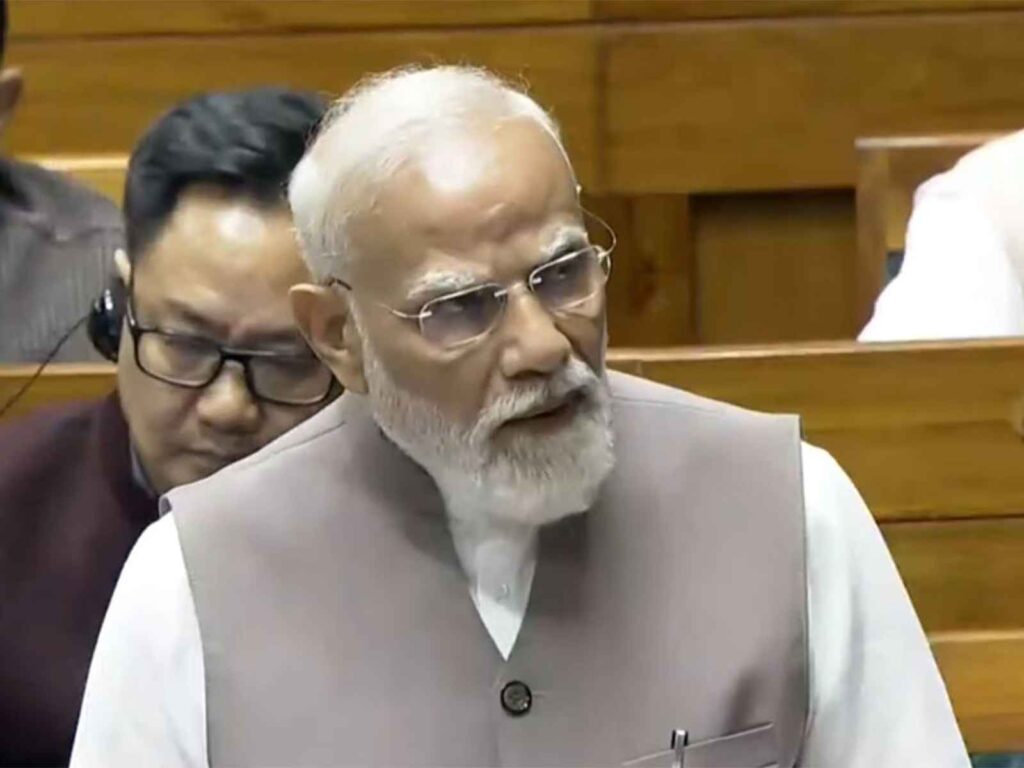
Prime Minister Narendra Modi presented his views on the West Asia war in Parliament on Monday. He stressed that the situation in West Asia is “worrying” due to the ongoing conflict between the US-Israel-Iran and it is having a serious impact on the global economy and people’s lives.
It is noteworthy that as the ongoing conflict in India has entered the fourth week, many challenges are emerging. Meanwhile, Prime Minister Modi, while addressing the Lok Sabha, said that these challenges are related to national security.
He stressed that “the unprecedented challenges posed by the conflict are also humanitarian.”
Prime Minister Modi said, “The situation in West Asia is worrying. This conflict has been going on for more than three weeks. It is having a serious impact on the global economy and people’s lives, and that is why the world is urging all parties for an early resolution of this conflict.”
The Prime Minister gave information about India’s trade relations with war-torn West Asian countries and said that most of the country’s requirement of crude oil and gas is met from the war-torn region. He also said that this sector also remains important as it provides routes for India’s trade with other countries.
He further said, “This war has also posed unprecedented challenges to India. These challenges are economic, national security related and also humanitarian. India has extensive trade relations with war-torn and war-affected countries. The region where this war is taking place is also an important route for our trade with other countries of the world. In particular, most of our requirements of crude oil and gas are met from this region.”
Emphasizing this, Prime Minister Modi said that at least one crore Indian citizens live in the Gulf countries, hence India’s concern about the ongoing war between America, Israel and Iran is naturally more. He stressed the need for a united voice regarding the conflict.
The Prime Minister said, “Approximately 1 crore Indians live and work in the Gulf countries. Commercial ships ply there. The number of Indian crew members is also very high. Due to these various reasons, India’s concerns are naturally high. Therefore, it is necessary that a unified voice and consensus reach the world regarding this crisis from the Parliament.”
He further said that all Indian citizens stranded in conflict-torn countries are being provided assistance by the government. The Prime Minister said that help is also being provided to the families of those who lost their lives during the conflict.
Prime Minister Modi said, “Ever since this war started, assistance has been provided to every Indian living in the affected countries. I have spoken on phone twice to the heads of state of most of the West Asian countries. All have assured the safety of Indians. Some people have lost their lives and some have been injured in this conflict. We are helping their families.”
PM Modi also informed that the Government of India is engaged in helping the citizens including tourists. He further said, “The Indian government is issuing advisories amid the ongoing conflict, and helplines and emergency helplines are operational 24×7.”
He said that more than 375 lakh Indian citizens have returned to the country safely, of whom at least 1000 were brought under protection from Iran.
The Prime Minister said, “More than 3,75,000 Indians have returned safely to India since the war began. About 1,000 Indians have returned safely from Iran so far, of which over 700 are medical students. In view of the situation, CBSE has canceled Class 10 and 12 examinations in schools in the Gulf countries and is taking necessary steps to continue the education of students without any interruption.”
He acknowledged that the challenge faced by cargo ships moving through the Strait of Hormuz is one of the impacts of the ongoing conflict, and informed about the efforts made by the Indian Government to ensure that supplies of petrol, diesel and gas are not affected.
Prime Minister Modi said, “A large quantity of crude oil, gas, fertilizers and many essential commodities come to India through the Strait of Hormuz. Since the outbreak of the war, movement of ships through the Strait of Hormuz has become extremely challenging. Despite this, our government has made efforts to ensure that the supply of petrol, diesel and gas is not seriously affected.”
The Prime Minister said that amid uncertainty in supply, the government has given priority to domestic LPG consumers.
He further said, “As we all know, the country imports 60 per cent of its LPG requirement. Due to uncertainty in supply, the government has given priority to domestic LPG consumers. At the same time, domestic production of LPG is also being increased. Continuous efforts are also being made to ensure smooth supply of petrol and diesel across the country. LPG production in the country is also being increased.”
The Prime Minister informed about the steps taken by the Government in the last 11 years to give priority to the storage of crude oil during such crises. He said that India has strategic petroleum reserves of more than 53 lakh metric tonnes.
Prime Minister Modi said, “India has strategic petroleum reserves of more than 53 lakh metric tonnes and the country is working on arranging reserves of more than 65 lakh metric tonnes. Our refinery capacity has also increased significantly in the last 11 years. The government is in constant touch with suppliers from different countries. Earlier we used to import from 27 countries; now we import from 41 countries.”
He further said, “The impact of the difficult situation created by this war in the world is likely to last for a long time, so we have to be prepared and remain united. We have faced such challenges with unity even during the Covid period, and now we need to be prepared again.”