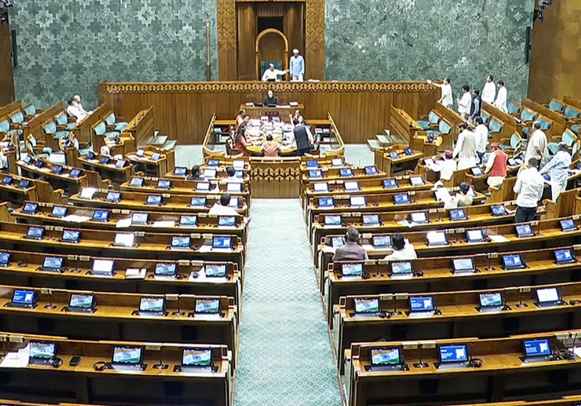
The Constitution (131st Amendment) Bill, 2026, the Delimitation Bill, 2026 and the Union Territory Laws (Amendment) Bill, 2026 were introduced in the Lok Sabha on Thursday, after the Opposition pressed against the move to introduce the three bills through division instead of voice vote.
Lok Sabha Secretary General Utpal Kumar Singh had explained the process of casting ‘yes’, ‘no’ or ‘absentee’ votes to achieve voting through the respective systems in the Lok Sabha.
Lok Sabha Speaker Om Birla initiated the division in the House to introduce the Constitution (One Hundred and Thirty-First Amendment) Bill, 2026.
Opposition members in the Lok Sabha had demanded a vote against the move to introduce the bill. According to the final division, out of total 333 votes, 251 votes were cast in favor and 185 votes were cast against.
With a majority of 251 votes, all three bills including the Constitution (One Hundred and Thirty-First Amendment) Bill, 2026 and the Delimitation Bill, 2026 were introduced in the Lok Sabha.
Voice voting is mainly used in the Lok Sabha. But if it is challenged, a “division” is conducted, where automatic vote recorders (yes, no, absent) are used.
Voting slips are now being used after the division of votes in the Lok Sabha, in which 333 members voted and no member was absent.
After the use of voting slips, the results are as follows: 251 in favor and 185 against. The government has called a special session of Parliament on April 16, 17 and 18 to pass amendments to the Nari Shakti Vandan Act.
The government is seeking the opposition’s support to pass an amendment bill to implement the Women’s Reservation Bill from the 2029 Lok Sabha elections based on the 2011 census.
Prime Minister Narendra Modi had urged opposition parties to support this amendment to ensure that reservation for women is implemented by the 2029 general elections.
“This is the wish of every sister and daughter of this country, and we have to fulfill it unanimously,” she said at an event in Dehradun on Tuesday.