
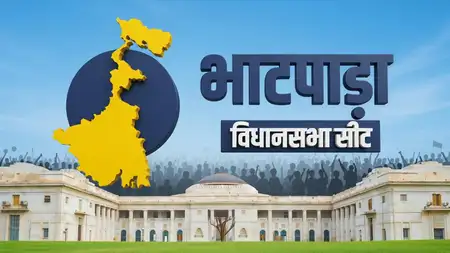
Bhatpara, 21 February (IANS). Bhatpara assembly seat, located in North 24 Parganas district of West Bengal, has been an important part of the electoral politics of the state since 1951. It is one of the seven assembly constituencies of Barrackpore Lok Sabha constituency and is entirely urban, comprising wards 1 to 17 of Bhatpara Municipality. Situated on the eastern bank of the Hooghly River, this area is a satellite city of Kolkata and comes under the purview of Kolkata Metropolitan Development Authority.
So far 18 assembly elections have been held in Bhatpara. For the first five decades, the Congress and Communist parties (CPI(M)) held the seat alternately. Both won six times each. The 21st century brought the wave of Trinamool Congress (TMC), where Arjun Singh won four consecutive times from 2001 to 2016.
Arjun Singh’s resignation (joining BJP) in 2019 led to by-elections, which proved to be a turning point. BJP’s Pawan Kumar Singh (Arjun Singh’s son) defeated TMC’s Madan Mitra by 23,104 votes. In 2021, Pawan Singh retained the seat by defeating TMC’s Jitendra Shaw by 13,687 votes. In 2021, BJP got 57,244 votes (53.4 percent), while TMC got 43,557 votes (40.63 percent).
BJP’s increasing hold in Bhatpara was also visible in the Lok Sabha elections. In 2014, the seat was ahead of the BJP by 2,515 votes, in 2019 the lead reached 29,707 votes and in 2024 the lead remained as low as 17,463 votes. Interestingly, the BJP did not win the Barrackpur Lok Sabha seat in 2014 and 2024, yet maintained a strong position at the assembly level.
The name of Bhatpara is associated with ‘Bhatta-Palli’, which was a settlement of Brahmin Sanskrit scholars. The traditional ‘Tol’ schools here were famous for Sanskrit education. In 1899, it was separated from Naihati and became a municipality. During the British period and after independence, it became an industrial hub due to jute mills. Jute processing attracted a large number of workers from outside, among whom the Hindi speaking community was prominent. Jute mills closed, but small manufacturing units, trading and the informal sector form the basis of the economy.
Talking about the geographical form, the area of this region is bounded by Hooghly River (West) and Sealdah-Krishnanagar Railway Line (East). Bhatpara railway station is on the Sealdah-Ranaghat line and the Barrackpore Trunk Road provides road connectivity. Naihati (5 km), Kanchrapara (8 km), Halisahar (6 km) and Chandannagar (10 km) in Hooghly district are nearby. Kolkata is just 25 km away.
–IANS
SCH/DKP