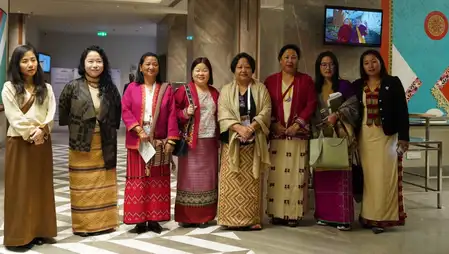
Itanagar, May 7 (IANS). Arunachal Pradesh Cultural Affairs Minister Dasanglu Pul on Thursday said women-led rural tourism has the potential to emerge as a powerful tool for promoting cultural exchange, sustainable development and regional cooperation in the Himalayan Buddhist region.
Addressing a regional workshop on ‘Development of Buddhist Circuit in North-East India’ held in Tawang, the Minister lauded the initiative aimed at connecting the Buddhist centers of North-East India with neighboring countries like Nepal, Bhutan and Sri Lanka through a women-led rural tourism model.
The workshop brought together representatives from Nepal, Bhutan, Sri Lanka, Assam and Sikkim and the main topic of discussion was to strengthen regional cooperation and promote sustainable tourism based on shared Buddhist heritage.
Highlighting the immense tourism potential of Arunachal Pradesh, Dasanglu Pul, who also holds the charge of the Ministry of Women and Child Development, said the state, often called the “Land of the Rising Sun”, is home to several important spiritual and cultural sites, including the Golden Pagodas located at Tawang, Mechukha and Namsai.
She emphasized that women in rural and tribal communities have traditionally played an important role in preserving oral traditions, handicrafts, indigenous cuisine, festivals and rituals.
He said involving them more actively in tourism initiatives would not only help preserve cultural heritage but also create livelihood opportunities and strengthen local economies.
The minister further said that the state government is committed to supporting working women through initiatives such as skill development programmes, micro finance support, infrastructure development and digital promotion of local tourism experiences.
Bridges also stressed the importance of strengthening tourism and cultural ties with neighboring Buddhist countries to promote international tourism and deepen people-to-people ties across the region.
The workshop featured speeches by representatives of the participating countries as well as technical sessions on the role of women-led rural tourism in promoting regional cooperation, connectivity, branding and inclusive growth.
Detailed discussions were also held on identification and promotion of major Buddhist heritage sites in the North Eastern Region as part of the broader tourism circuit.
Officials described the workshop as an important step towards enhancing regional cooperation and unlocking the vast tourism potential of Northeast India through an inclusive, community-driven and sustainable development model.
–IANS
DKP/