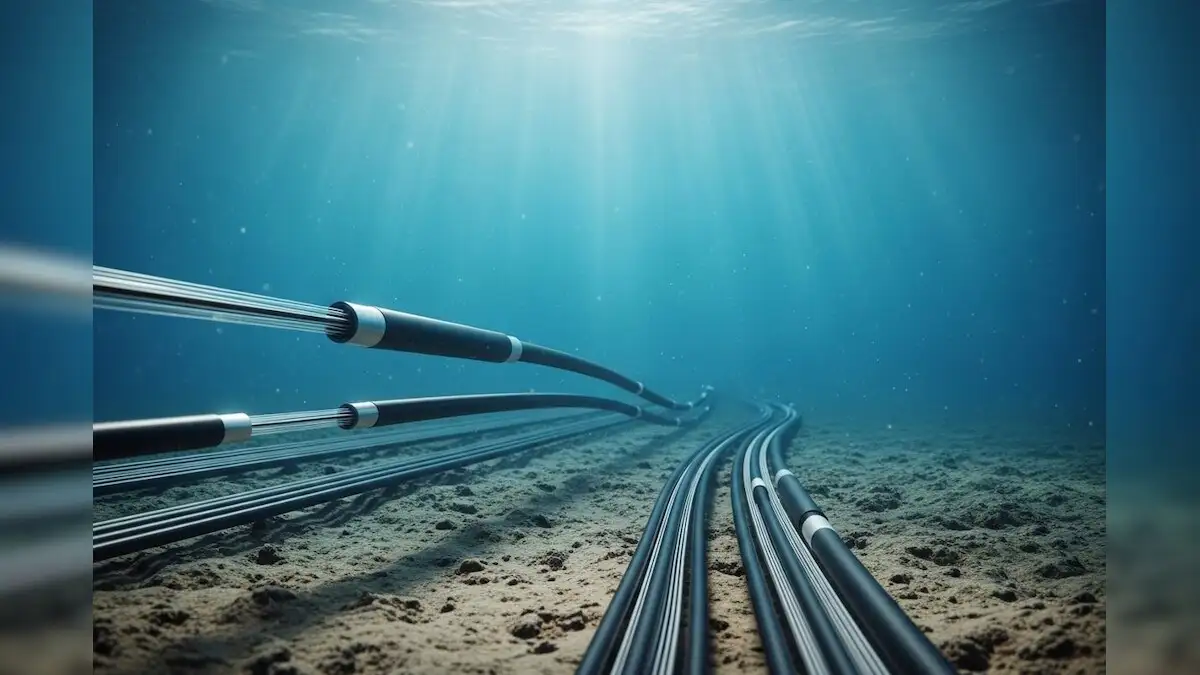
There is currently a conflict going on in the Middle East between Iran and America. Amidst this situation, something has come to light that can worry the entire world. According to a report by Iran’s Tasnim News Agency, while the strait has historically been considered an important route for oil and maritime traffic, the threat has now expanded to its underwater internet cables. The undersea data cables in the Strait of Hormuz are extremely sensitive, and any disruption to them could have a major impact on internet services across the region. The report clearly states that if multiple cables are damaged at the same time—whether accidentally or intentionally—it could cause a widespread internet outage throughout the Persian Gulf region.
The Strait of Hormuz is vital not only for oil transportation but also for digital connectivity. Several major submarine cable systems—such as FALCON, AAE-1, TGN-Gulf, and SEA-ME-WE—pass through or very close to this route. These are the same cables that run the internet, banking, cloud services and communication networks of the Gulf countries. The biggest problem is that all these cables are concentrated in a single, narrow geographical corridor, which significantly increases the risks associated with them. According to the report, countries like UAE, Qatar, Bahrain, Kuwait and Saudi Arabia are heavily dependent on these cables; As a result, any disruption could have an immediate and serious impact on these countries.
Threats related to the Strait of Hormuz
The threat associated with the Strait of Hormuz is not merely a matter of speculation; In fact, similar incidents have happened in the past as well. In the years 2024 and 2025, several underwater cables laid in the Red Sea were damaged, resulting in slow internet speeds and disrupted services in many places. The repair work on these cables lasted for months as carrying out repair work in that specific area was quite challenging in terms of logistics and operations. There have been several previous cases when Yemen-backed Houthi rebels have targeted such infrastructure, raising fears that internet cables could become the focus of major conflicts in the future. Experts believe that Tasneem’s report is not only an informative update, but also a signal that emphasizes how important and sensitive these cables really are. The report specifically addresses cable routes, landing stations and data centres, underscoring that any disruption at these locations could have far-reaching consequences.
Bay Area’s Major Data Center
In the Gulf countries—particularly the UAE and Bahrain—data centers and cloud infrastructure are highly concentrated in certain locations; This centralization can greatly magnify the impact of any potential outage. Recently, there have also been reports that Iranian drone strikes had targeted certain locations in the UAE and Bahrain that were connected to Amazon Web Services. Although the full details have not yet been revealed, these incidents clearly show that digital infrastructure is fast becoming a battlefield of modern warfare. Protecting undersea cables is a very difficult task. Even the slightest damage to these cables can severely disrupt data traffic, slow down banking systems, and disrupt communications between countries. Although no immediate and major threats have emerged so far, the warning has drawn attention to a form of infrastructure that is largely invisible, yet vital to both our everyday lives and the global economy.