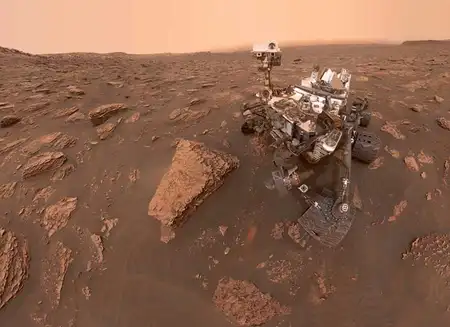
New Delhi, May 28 (IANS). Canada’s state-of-the-art Alpha Particle X-ray Spectrometer (APXS), which is continuously working on the surface of Mars, has so far analyzed 1761 samples and sent 3943 results to Earth. This instrument has been installed on the Curiosity Rover of the American Space Agency NASA, which has been investigating the soil and rocks of the Red Planet for the last several years.
The Canadian Space Agency posted on the official Instagram account and shared updates related to APXS. According to the agency, APXS is helping scientists understand what elements the surface of Mars is made of and whether there ever existed conditions favorable to life.
The Alpha Particle X-ray Spectrometer looks almost like a Rubik’s Cube (3D puzzle) in shape. It is attached to the end of the robotic arm of the Curiosity rover. When the rover approaches a rock or soil sample, the instrument moves closer to the sample and bombards it with X-rays and alpha particles. After this, by studying the energy released from the sample, scientists find out its chemical structure.
According to scientists, APXS is capable of identifying even the smallest elements present in a sample. It takes about two to three hours to perform a detailed analysis of a sample, while the rapid test can be completed in about 10 minutes. This is why this instrument is continuously gathering important scientific information on the surface of Mars.
In the year 2024, APXS played an important role in a major discovery. When the Curiosity rover passed over a rock, it was broken, inside which scientists found crystals of pure sulfur. Scientists were very excited when such crystals were found for the first time on Mars. It is believed that this discovery will help in understanding the old atmosphere of Mars and the natural conditions present there.
The Canadian Space Agency reported that APXS can operate continuously both day and night. This device is operated by a thermoelectric generator, which produces energy. For this reason, the Curiosity Rover does not have to depend on solar energy and remains active even in the harsh winter of Mars.
By February 1, 2026, the Curiosity rover has covered a distance of 36.2 kilometers on the surface of Mars. During this period, APXS has collected thousands of scientific data and sent it to Earth. Scientists believe that this information will be of great help in preparing for future human missions to Mars and understanding the possibilities of life there.
Canada has extended its participation in this mission till March 2029. In such a situation, more important discoveries are expected from APXS in the coming years.
–IANS
mt/pm