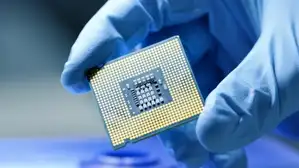
New Delhi, May 5 (IANS). The Union Cabinet chaired by Prime Minister Narendra Modi on Tuesday approved two new semiconductor projects under the Bharat Semiconductor Mission. This decision is being considered a big step towards strengthening chip manufacturing in the country.
Both these projects will be set up in Gujarat, in which total investment will be around Rs 3,936 crore. These projects are expected to provide employment to about 2,230 skilled people.
One of these projects will be the country’s first commercial mini/micro-LED display facility, which will be based on Gallium Nitride (GaN) technology. Apart from this, a semiconductor packaging unit will also be established.
The first major project will be developed by Crystal Matrix Limited in Dholera, Gujarat. This plant will work on compound semiconductor manufacturing, assembly, testing, marking and packaging (ATMP), with a special focus on manufacturing mini/micro-LED display modules.
The unit will also provide GaN foundry services and produce 72,000 square meters of display panels and 24,000 RGB wafers per year. These will be used in new technology devices like TV, smartphone, automobile display, smartwatch and XR (Extended Reality).
The second project will be set up by Suchi Semicon Private Limited in Surat. It will be an outsourced semiconductor assembly and test (OSAT) unit, which will produce more than 1,033 million chips every year.
These chips will be used in power electronics, analog circuits and industrial systems, which will benefit sectors like automobile, industrial automation and consumer electronics.
With these two new projects, the total number of projects under Bharat Semiconductor Mission has increased to 12 and the total investment has reached about Rs 1.64 lakh crore.
The government believes that this will strengthen India’s semiconductor capability and will provide further support to the country’s growing strength in the field of chip design.
The government also informed that design infrastructure support is being provided to 315 educational institutions and 104 startups to promote the semiconductor sector in the country.
Work on several already sanctioned projects is progressing at a rapid pace, out of which two units have started production and two more are scheduled to start operations soon.
–IANS
DBP