
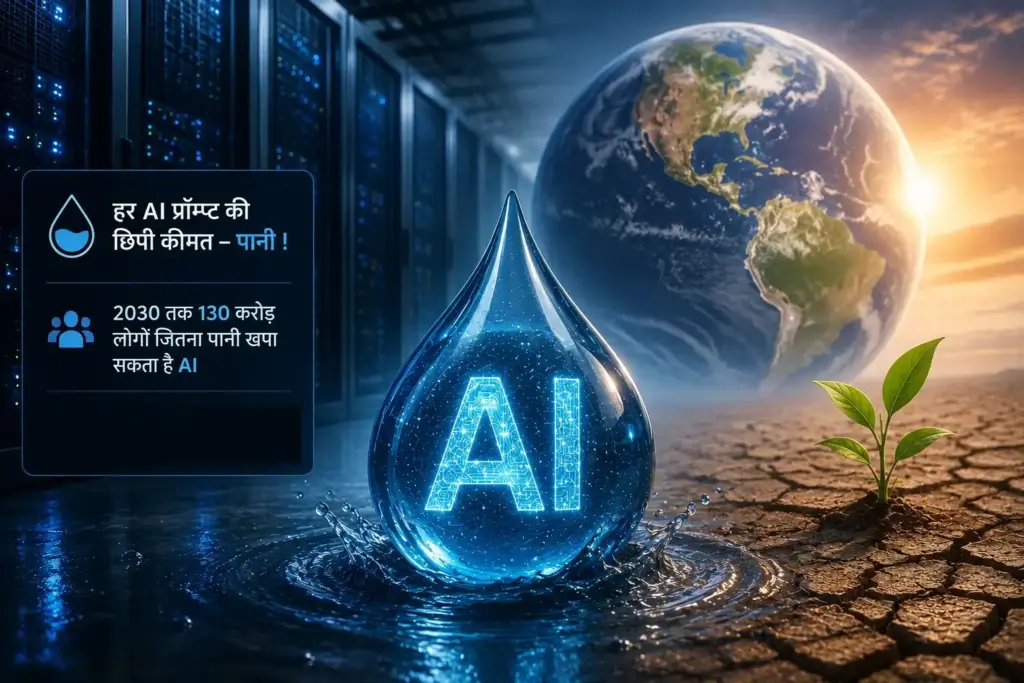
The craze for AI is increasing rapidly around the world, and its dangerous consequences are also clearly visible. Protests are taking place against AI in many countries. According to a report by UN University, the rapidly increasing use of AI is putting huge pressure on resources like energy, water and land. It is no longer just a matter of technology; This has become a serious issue related to the environment and future sustainability.
**Companies are spending heavily on AI and are also laying off employees**
Talking about electricity alone, the International Energy Agency estimates that data centers around the world could consume about 945 terawatt-hours of electricity by 2030. To understand the scale of this data, let’s understand it in simple terms.
**Electricity consumption equal to that of an entire country!**
The electricity consumption of 945 terawatt-hours is equivalent to the annual electricity consumption of an entire country like Japan. In other words, AI and data centers alone will consume as much electricity as a fully developed country. This could amount to about 3 percent of total electricity consumption worldwide. To put it in simpler terms: the amount of electricity an average Indian household uses in a year can power thousands of homes; Yet, when millions of people simultaneously ask questions of an AI system, AI servers consume that much power in a matter of seconds. Earlier electricity was mainly used in factories, homes and transportation. Now, a big part of it is being used in the digital world – something that may not be visible, but which has a huge impact. However, the real crisis is about water. According to a report by Earth.Org, AI data centers could use an estimated 9.3 trillion liters of water by 2030. This water is used to keep the servers cool, as the chips running the AI models generate a lot of heat.
**Water equal to the need of 1.3 billion people**
It is important to understand this figure: 9.3 trillion liters of water is equivalent to the water needs of approximately 1.3 billion people. In other words, the amount of water required by the entire population of a country like India can only be used to cool the machines. To put it simply: Imagine a city where there is a daily water crisis, where people are dependent on water tankers and are constantly appealing to save water; Meanwhile, data centers are using millions of liters of water just to keep their servers cool. In fact, when people are struggling with water shortage, machines are using the same resource. Now there is increasing opposition on this issue not only among experts but also among the general public. Opposition to AI data centers is growing, especially in the US.
Opposition to data centers in America
According to reports, people in many cities of America have opposed data center projects, the main reason for which is the heavy consumption of water and electricity. Local people say that these data centers can further increase the water shortage in their areas and put pressure on the power grid. In some cases the projects have even been stopped. Last year in the US, nearly $200 billion worth of data center projects were either stopped or delayed due to public opposition. This shows that this issue is no longer just a technical matter, but has become a significant public concern.
People fear that companies are using local resources to run AI, while common people are not getting any significant benefit from it. This concern is greater in areas where there is water shortage. UN reports also clearly warn that the expansion of AI infrastructure is putting pressure on water, land and climate. The expansion of data centers can become a major problem, especially in areas that are already water-stressed.
Perhaps most surprising is that most of the power consumption in AI occurs not during training, but during daily use. According to IEA analysis, about 80 to 90 percent of energy consumption occurs during “prediction” – that is, when we ask AI questions. This means that every time you ask ChatGPT a question, capture an image, or create an AI video, servers are activated, consuming electricity and using water for cooling. In short, the more AI is used, the greater the pressure on resources.
Is there any solution to this?
Tech companies are now working on green energy, water recycling and new cooling systems. Many companies claim that they are trying to run their data centers using solar or wind energy. However, the real challenge is that the demand for AI is growing so rapidly that it may be difficult for these efforts to keep pace with it.