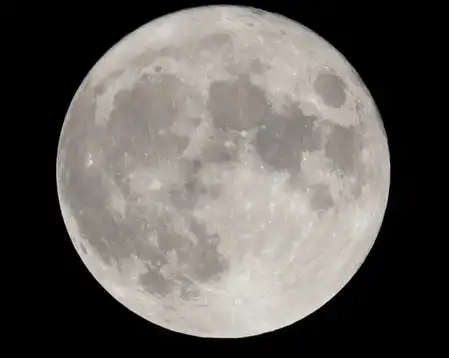
New Delhi, May 30 (IANS). On May 31, a beautiful view of Purnima i.e. full moon will be seen in the sky. Full Moon is the astronomical condition when the Earth-facing part of the Moon is completely illuminated by sunlight. During this time the moon appears in its brightest form. However, the size and shape of the moon seems to change every night. This variation is caused by the different phases of the Moon, which change continuously over a cycle of approximately 29.5 days.
According to scientists, the Sun is the only body in our solar system that emits light on its own. Sunlight falls on the Earth and the Moon. The Moon does not create its own light, but reflects the Sun’s light. We see this reflected light as moonlight. The Moon continuously revolves around the Earth, due to which its illuminated part visible from the Earth keeps changing.
There are a total of eight major phases of the Moon. These include new moon, waxing crescent, first quarter, waxing gibbous, full moon, waning gibbous, third quarter and waning crescent. This entire cycle is repeated approximately every 29.5 days.
A full moon occurs when the Earth, Moon and Sun are almost in line. When viewed from Earth, the Moon is located in the exact opposite direction of the Sun. In this situation, the entire illuminated part of the Moon is visible from the Earth and it appears round and very bright. The full moon usually rises at sunset and sets at sunrise.
There are also special lunar phenomena in astronomy such as the Supermoon, Blood Moon, Blue Moon and Harvest Moon. During a supermoon the Moon is relatively close to the Earth, making it appear larger and brighter than usual. At the same time, during a blood moon, in the event of a lunar eclipse, the moon may appear red.
Hearing the name Blue Moon, one may get the impression of blue color of the moon, but in reality its color is not blue. A blue moon is usually the second full moon that occurs in the same calendar month. The full moon on May 31 will also be a blue moon. According to another definition in astronomy, if there are four full moons in a season, the third full moon is also called Blue Moon.
–IANS
MT/AS