
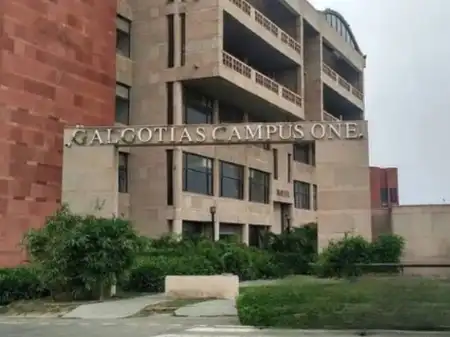
Greater Noida, February 18 (IANS). Controversy continues over the controversial incident that took place at the India AI Impact Summit 2026 involving Galgotias University. Meanwhile, on Wednesday the university apologized for the incident.
There was a huge outcry on social media after a representative in the University Pavilion at the Summit presented Chinese company Unitri’s robotic dog ‘Orion’ (Unitri Go2) as a product developed at the University’s Center of Excellence. The university was even asked to vacate its stalls from the expo area of the summit.
The university issued a press release saying, “We apologize for the confusion that occurred at the recent AI Summit. One of our representatives present at the pavilion had incorrect information. He was not aware of the technical origin of the product and in the excitement of being on camera, he provided incorrect information, even though he was not authorized to speak to the press.”
The university clarified that there was no institutional intention to misrepresent this innovation. They are fully committed to academic integrity, transparency and responsible performance. Understanding the sentiments of the organisers, they have vacated the premises.
The controversy started when Professor of Communications Neha Singh in an interview described ‘Orion’ as developed by the university’s Center of Excellence. When the video went viral, users identified it as Unitri Go2, which is a commercial product made in China and available in India for Rs 2-3 lakh. It was trolled on social media as ‘misrepresentation’ and ‘lies on Indian AI progress’.
Earlier, the university had posted on the social media platform
The university had said, “The vision of our university is on student learning and innovation and we provide students with access to modern technology so that they can gain practical experience and be prepared for the future. Spreading negativity can demotivate students who are working hard to innovate, learn and build their skills using global technology.”
–IANS
SCH/ABM