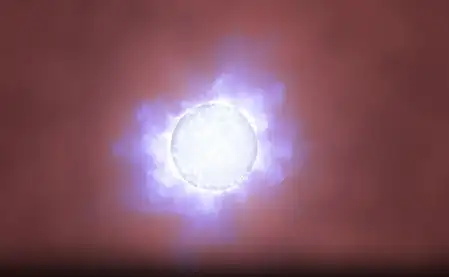
New Delhi, May 13 (IANS). Gamma-ray bursts are one of the most powerful and mysterious phenomena in the universe. These are such intense and energetic explosions that their luminosity can be many times greater than that of our Sun. Astronomers say that these are the biggest explosions in the universe, which happen somewhere or the other almost every day.
They were first detected through satellites in the 1970s. After decades of research, scientists now understand that these explosions occur very far away, millions of light years away, yet release so much powerful energy that they can be easily seen from Earth.
There are two types of gamma-ray bursts. The first short gamma-ray bursts, or short GRBs, last less than two seconds. These mainly occur due to the collision of neutron stars or the fusion of a neutron star and a black hole. After the collision, a new or larger black hole is formed. At the same time, long gamma-ray bursts or long GRBS, these two seconds or more usually last up to a minute. These are associated with the extinction of very large and massive stars. When such a star runs out of fuel at the center, the star collapses under its own gravity and a black hole forms at its center.
Now the question is how do these explosions occur? So let us tell you that in both the cases the newly formed black hole releases narrow rays of extremely fast moving particles i.e. jets in opposite directions. These jets move close to the speed of light. When these jets collide with surrounding gas and dust, fierce gamma rays are produced. As these jets move forward, their speed slows down and they lose energy. This process creates an ‘afterglow’, which starts from gamma rays and extends to X-rays, visible light, infrared and radio waves.
The special thing is that scientists get the most information about GRBS from these afterglows, which can be tracked for several days or years. Gamma-ray bursts are not only the most dangerous events in the universe but they also play an important role in understanding mysteries like black holes, neutron stars and the death of giant stars. Scientists are still busy solving many of their puzzles.
–IANS
mt/pm