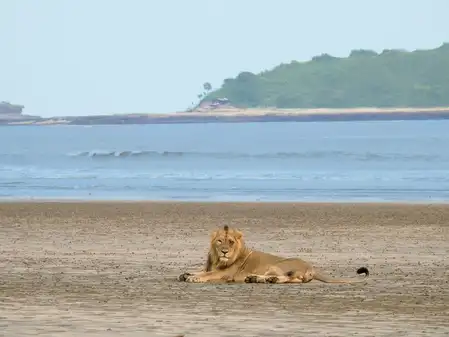
Gandhinagar, July 18 (IANS). A study has come out regarding the Asiatic lions living on the coast of Gujarat. A new scientific study has found that Asiatic lions living on the coast of Gujarat depend mainly on wild prey rather than domesticated animals. After this study, the old thinking has changed that this species moved from Gir forests in search of cattle.
The research, published in the peer-reviewed international journal ‘Conservation’, found that about 70 per cent of the biomass consumed by coastal Asiatic lions comes from wild prey, demonstrating the ecological feasibility of this species growing in habitat outside the Gir Protected Area.
This result has come to light when according to the 16th Lion Population Estimation done in 2025, the population of Asiatic lions in the state has reached 891.
The authors of the study titled ‘Dietary Pattern of Asiatic Lions in the Coastal Ecosystem of Saurashtra, Gujarat, India’ are Mohan Ram, Aradhana Sahu, Nityanand Srivastava, Kritya Vadar, Rohit Chaudhary and Lahar Jhala.
Researchers analyzed fecal samples of 160 lions collected from the coastal districts of Junagadh, Gir Somnath, Amreli, Bhavnagar and Porbandar during March and April 2024.
Mohan Ram, Conservator of Forests, Junagadh Circle, and one of the authors of the study, said, “Our study analyzed fecal samples of 160 lions collected from the coastal districts of Junagadh, Gir Somnath, Amreli, Bhavnagar and Porbandar during March and April 2024 and our study found that wild prey accounted for 64 percent of the lions’ diet, while domesticated animals accounted for 64 percent. The share was 31 percent. In terms of biomass used, wild prey accounted for 70 percent, while animals accounted for 30 percent.”
He said that Nilgai has emerged as the main prey of lions. “Of all the prey species, nilgai became the main source of food for lions, accounting for more than half (51 per cent) of the total biomass consumed. Wild boars were the second largest wild prey, while cattle were the largest domestic prey,” Ram said.
The researchers said the results were contrary to their original thinking that lions living in human-populated coastal areas would be more dependent on animals due to less availability of wild prey.
The study concluded that due to the presence of good populations of Nilgai and wild boars in the coastal areas of Gujarat, lions are doing most of the hunting, which may reduce the pressure on the animals and help in reducing human-lion conflicts.
According to the study, Gujarat’s coastal ecosystem now supports three essential satellite populations of Asiatic lions on the south-west coast, south-east coast and Bhavnagar coast.
A total of more than 100 Asiatic lions are estimated to exist in these coastal areas, demonstrating the continued spread of the species beyond the Gir forests.
The researchers also found that coastal lions have a specialized diet, consisting mostly of nilgai and wild boar. This shows that the abundance of prey and the quality of their habitat greatly influence their feeding patterns.
Although the lions’ diet also includes cattle and buffalo, the study notes that most of the cattle eaten are considered wild animals, which is in abundance in some parts of Saurashtra, as animals that do not work are often abandoned.
Their lack of meeting and anti-predator behavior makes them easier prey than protected animals.
The study emphasized that for the long-term survival of Asiatic lions outside protected forests, it will be necessary to protect wild prey populations.
Forest and Environment Minister Arjun Modhwadia said the results show that lions living outside the Gir forests are also benefiting agriculture. He said, “Research study shows that the lion population outside the Gir forests is benefiting the farmers by hunting Nilgai and wild boars. Both of them cause damage to the crops. In such a situation, by controlling their population, the lions are helping in reducing the damage to the crops.”
–IANS
sd/as