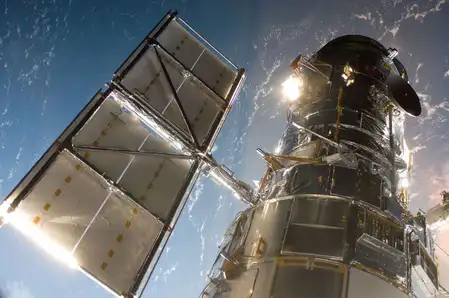
New Delhi, March 28 (IANS). The Hubble Space Telescope is often called a time machine of the universe. It also lets us travel back in time by capturing light coming from distant cosmic objects. Light takes time to reach Hubble, so the images we see today show those objects as they appeared years or billions of years ago.
The special thing is that astronomy can also be called cosmic archaeology. Through light we discover the secrets of the life of those bodies and the evolution of the universe. Telescopes like Hubble help us understand where we are in the universe and how it works. It doesn’t just take pictures, but takes us to the edge of time. Scientists use Hubble’s data to piece together the history of the universe and find answers to its unresolved questions.
The Hubble Space Telescope is not just a telescope. It is also an observatory, a satellite and a scientific-cultural symbol. It rotates in the lower orbit of the Earth at an altitude of about 550 kilometers. It takes approximately 95-96 minutes to complete one round trip from here. Being above Earth’s hazy atmosphere, Hubble is able to capture clear and amazing views of the universe.
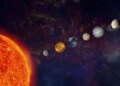
The secret of its time travel is hidden in the light. In astronomy ‘light-year’ is a unit of distance. This is the distance that light travels in one year. The speed of light is approximately 3 lakh kilometers per second. Light travels a distance of about 9.5 trillion kilometers in one light-year. For example, the Sun is about 150 million kilometers away from the Earth. Its light takes about 8 minutes to reach us. So when we look at the sun, we see it as it was 8 minutes ago. This distance is very small on the scale of the universe. The nearest star after the Sun is Proxima Centauri, located about 4.2 light-years away.
Even in Hubble’s powerful eye it appears to be a tiny dot. This gives an idea of the vastness of the universe. Time travel gets even more exciting when Hubble looks at objects far beyond our solar system. The galaxy named GN-Z-11 is one of the most distant known galaxies in the universe. It has taken us 13.4 billion years to reach its light. This means Hubble lets us see the galaxy as it was just 400 million years after the Big Bang, when the universe was just 3 percent of its present age.
Similarly, the star named ‘Earendale’ is the most distant star observed by Hubble. Its light is 12.9 billion years old. When this light was released, the universe was only 7 percent of its current age. Scientists gain important information about the early stages of the universe from these distant observations. Hubble gives us a glimpse of the earliest times of the universe.
–IANS
mt/pm