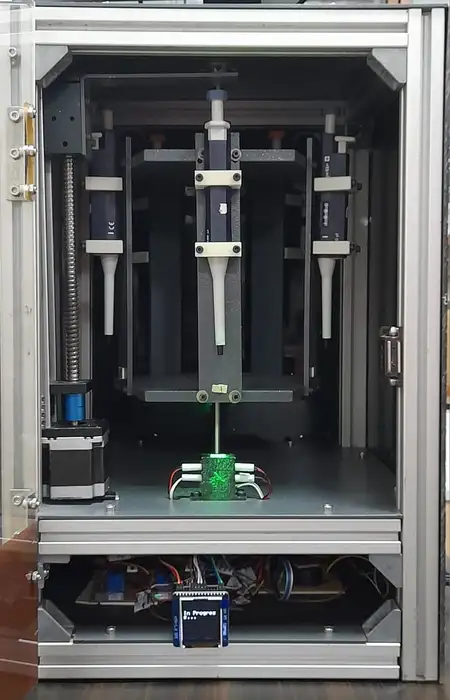
New Delhi, November 17 (IANS). Researchers from Indian Institute of Technology (IIT) Madras and Punjab University have jointly created a device that identifies pesticides very well. It is a portable, automated optical device that is capable of detecting pesticides present in water, food and the environment.
It can detect extremely low concentrations of pesticide residues that pose a serious risk to humans and the environment.
Traditional laboratory methods for detecting such residues are quite complex and expensive. The organophosphate malathion in particular is expensive and time consuming. Not only this, they also require skilled personnel.
This new discovery is being supported by the Department of Science and Technology under the ‘Technology Development and Transfer’ programme. It is a device that can be easily installed in any area, is user friendly and is capable of detecting highly sensitive pesticides.
The new ‘Smart MDD (Malathion Detection Device)’ is a colorimetric (a method used to measure the concentration of a chemical compound in a solution) detection system using gold nanoparticles (AuNPs) coupled with an aptamer molecule. These are designed to specifically detect malathion.
Due to this interaction a visible change in color is visible. The red color changes to blue indicating the presence of pesticide, a change that the instrument’s built-in optical system accurately measures. The team said this automated process eliminates manual handling and provides quick, reliable results. These findings have been published in Review of Scientific Instruments.
Professor of Applied Mechanics and Biomedical Engineering, IIT Madras. Sujata Narayanan Unni told IANS, “This technology can prove to be very useful. It helps farmers, food safety agencies and environmental regulators to detect the harm caused by pesticides whether the (pesticide) particles are in irrigation water, produce or soil. This will help in ensuring compliance with safety standards and reducing public health risks.”
“It can also help in monitoring the flow of pesticides into water bodies, which is a major environmental concern,” Unni added.
The team identified approximately 250 picomolar molecules and examined their correlation with spectrophotometer results. Measurements that are rarely seen in portable devices.
Currently it is being tested in the laboratory. Soon this equipment will be used to test samples of fruits, vegetables and farm water sources.
“We plan to expand this platform to detect a wider range of pesticides, further strengthening its role in sustainable agricultural management and environmental monitoring,” Dr Rohit Kumar Sharma of the Department of Chemistry and Center for Advanced Study in Chemistry, Panjab University, told IANS.
–IANS
kr/